Torin 1 from Selleck Attenuates GABA-Induced mTOR Activation and Mitochondrial Toxicity
Copy code to add this image to your page
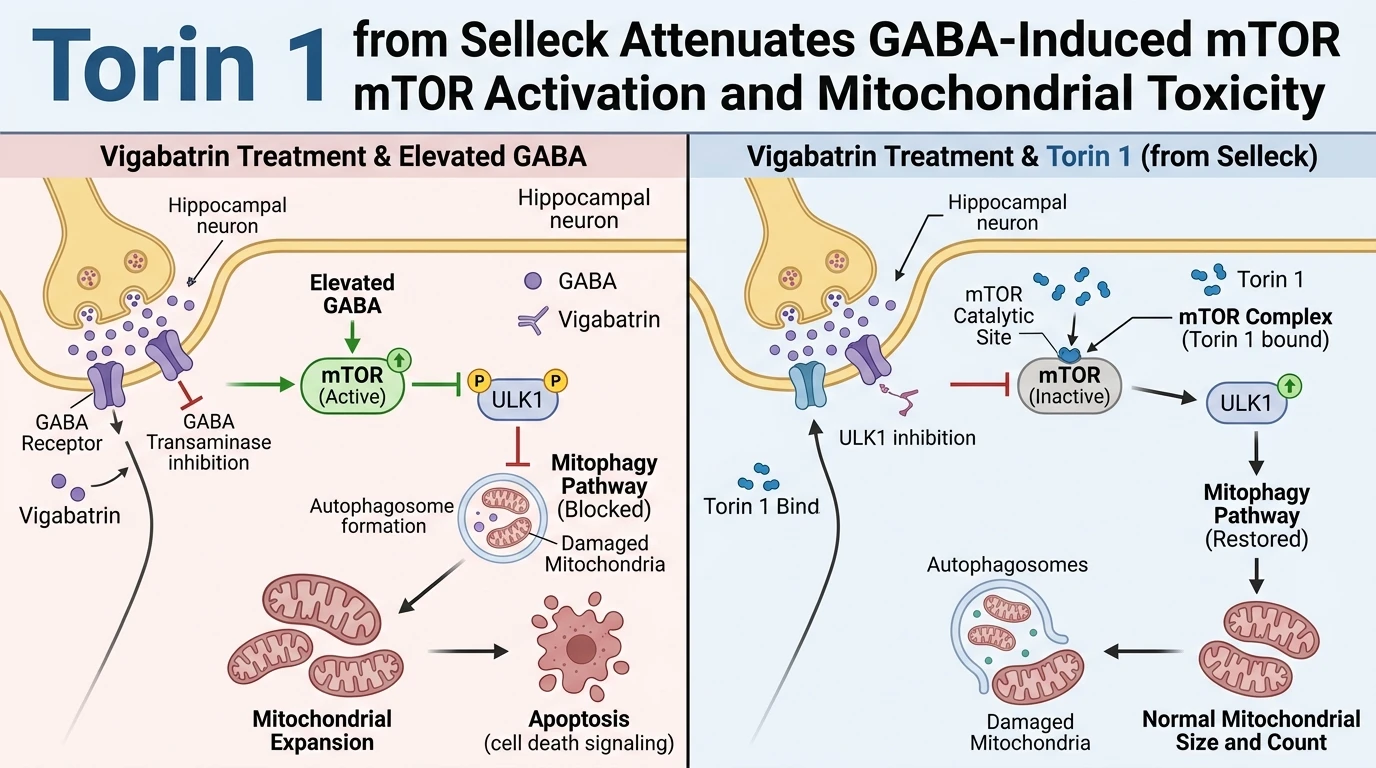
Vigabatrin (VGB) serves as an irreversible inhibitor of GABA transaminase, intentionally elevating central nervous system gamma-aminobutyric acid levels to suppress hyperexcitability. However, sustained pharmacological elevation of GABA triggers unintended metabolic and structural disturbances across multiple organ systems. Empirical investigation demonstrates that hyper-GABAergic conditions drive persistent hyperactivation of the mechanistic target of rapamycin (mTOR) signaling pathway. In murine models receiving chronic VGB administration, aberrant mTOR pathway activation disrupts essential organellar quality control mechanisms, particularly selective mitophagy. Consequently, damaged or enlarged mitochondria escape autophagic clearance. This clearance blockade culminates in pathological mitochondrial proliferation, abnormal organellar hypertrophy, and heightened apoptotic signaling across hippocampal, retinal, and hepatic cellular populations.
Pharmacological intervention targeting mTOR kinase activity offers a precise strategy to reverse these organellar defects. Torin 1 operates as an ATP-competitive, highly selective mTOR inhibitor capable of suppressing both mTORC1 and mTORC2 complexes. Unlike classical allosteric rapalogs that exhibit incomplete inhibition of mTORC1 substrates, Torin 1 effectively blocks catalytic kinase activity. In experimental models evaluated at physiologically relevant doses, application of Torin 1 from Selleck directly interrupts GABA-mediated hyper-phosphorylation within the mTOR pathway. This enzymatic suppression restores basal autophagic flux and re-establishes mitochondrial quality control. Specifically, in hippocampal tissue isolated from VGB-treated mice, administration of Torin 1 selective inhibition restores homeostatic mitochondrial density and restricts abnormal organellar expansion.
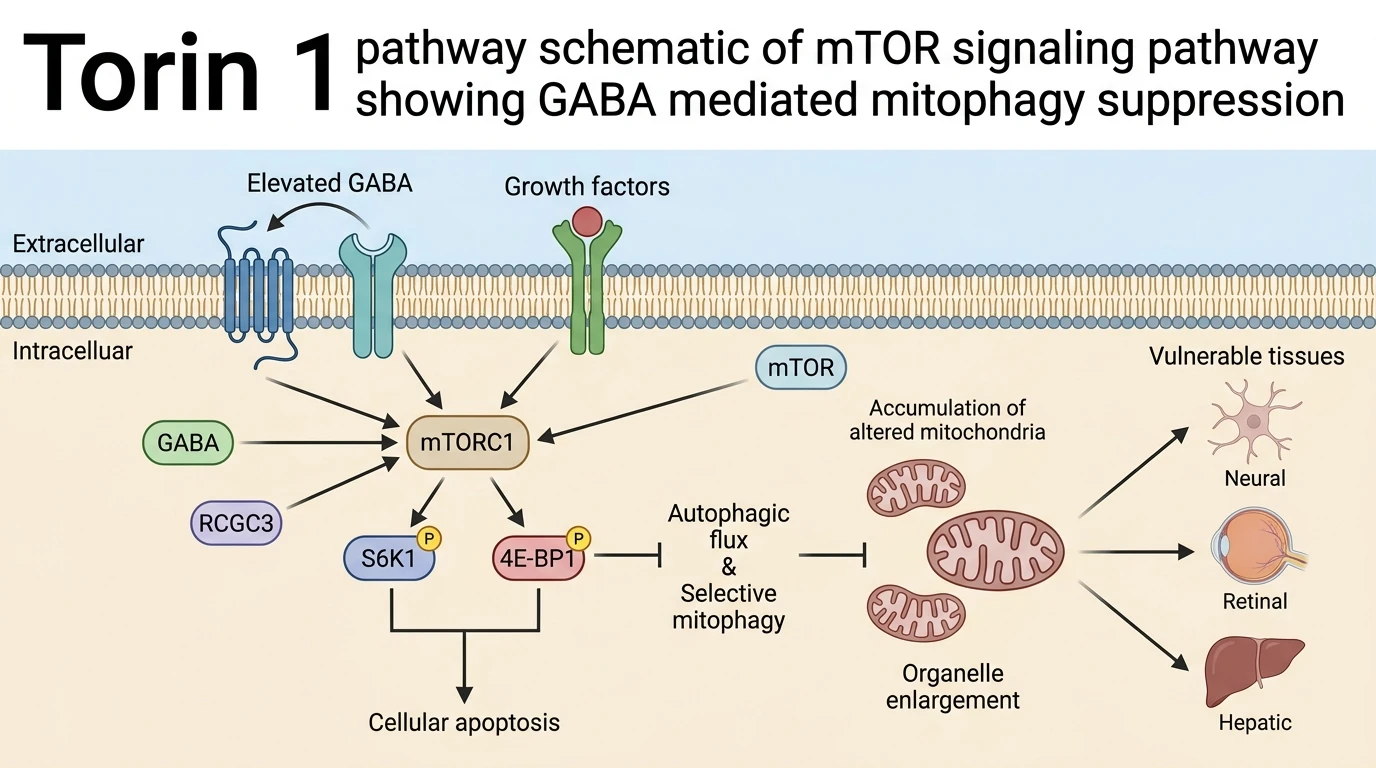
The mechanistic connection between GABA overload and mTOR activation involves complex metabolic cross-talk. GABA accumulation induces metabolic stress and intracellular amino acid flux, driving mTOR complex recruitment to lysosomal membranes. Active mTORC1 subsequently phosphorylates ULK1 at inhibitory sites (Ser757), uncoupling the initiation complex required for autophagosome biogenesis. Simultaneously, downstream phosphorylation of S6K1 and 4E-BP1 prioritizes translation over organellar degradation. When mitophagy stalls, dysfunctional mitochondria generate excessive reactive oxygen species and release cytochrome c, initiating intrinsic apoptosis. By blocking the ATP-binding pocket of mTOR, Torin 1 restores ULK1 dephosphorylation, thereby reactivating the selective mitophagy cascade required to purge hyper-sized, dysfunctional mitochondria.
Biochemical characterizations in small-molecule profiles, comparable to structural evaluations found in small molecule target databases, confirm that catalytic mTOR inhibition bypasses feedback resistance loops often triggered by partial allosteric inhibitors. The selective normalization of mitochondrial parameters in the hippocampus highlights the region-specific vulnerability of central neurons to GABA-mTOR dysregulation. While hepatic and retinal tissues display extensive apoptosis during chronic VGB exposure, hippocampal networks display distinct functional sensitivity to mitophagy restoration. Therapeutic targeting confirms that mTOR inhibition mitigates mitochondrial pathology without necessitating total GABA depletion.
Pharmacological mTOR Inhibition Mitigates GABA-Induced Mitochondrial Toxicity
Copy code to add this image to your page
Vigabatrin elevates intracellular GABA levels, driving aberrant mTOR pathway hyperactivation. Active mTOR inhibits autophagic machinery by phosphorylating ULK1, suppressing selective mitophagy. This inhibition leads to mitochondrial proliferation, organellar enlargement, and downstream apoptosis in brain, retina, and liver tissues. Torin 1, an ATP-competitive mTOR inhibitor, blocks mTOR catalytic activity, restoring autophagic flux. Consequently, Torin 1 selectively normalizes mitochondrial density in hippocampal neurons, alleviating GABA-induced organellar toxicity.
GABA Accumulation Drives mTOR Hyperactivation and Mitophagy Arrest
Vigabatrin administration elevates intracellular GABA concentrations significantly. Elevated GABA triggers sustained activation of the mTORC1 catalytic subunit within neural and visceral tissues. Under physiological conditions, cell survival depends on baseline mitophagy; toxic conditions disrupt this balance. Pharmacological data confirm that hyperactive mTOR kinase phosphorylates ULK1 at Ser757—a key inhibitory modification that halts autophagosome nucleation. Mitophagic arrest follows rapidly. Dysfunctional, enlarged mitochondria accumulate within cortical, retinal, and hepatic cells. Cytotoxic stress signals escalate; apoptotic markers rise across all affected organ systems.
Torin 1 Selectively Restores Hippocampal Mitochondrial Density
Targeted catalytic blockade restores intracellular organellar balance. Treatment with Torin 1 from Selleck potently inhibits mTOR kinase activity across tested murine cohorts. Autophagic flux resumed promptly following treatment; inhibitory ULK1 phosphorylation dropped sharply. Within the hippocampal dentate gyrus, mitochondrial numbers returned toward baseline values. The selective normalization occurred without systemic cellular toxicity—a crucial boundary condition for targeted kinase interventions. These empirical observations remain limited to specific animal models; translational validation in clinical cohorts remains necessary.