MS023 MS023 polysaccharide biostimulation activates plant defense enzymes and cuticular lipid remodeling
Copy code to add this image to your page
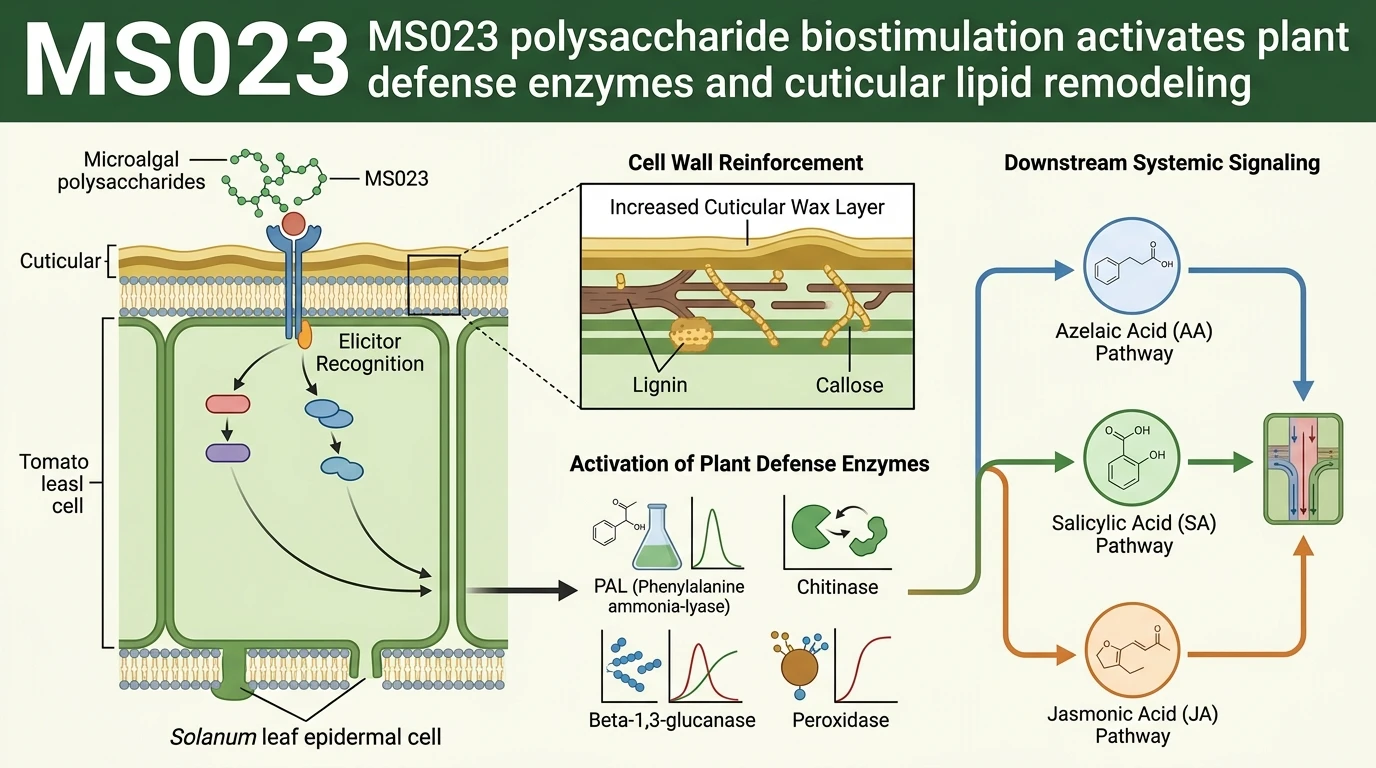
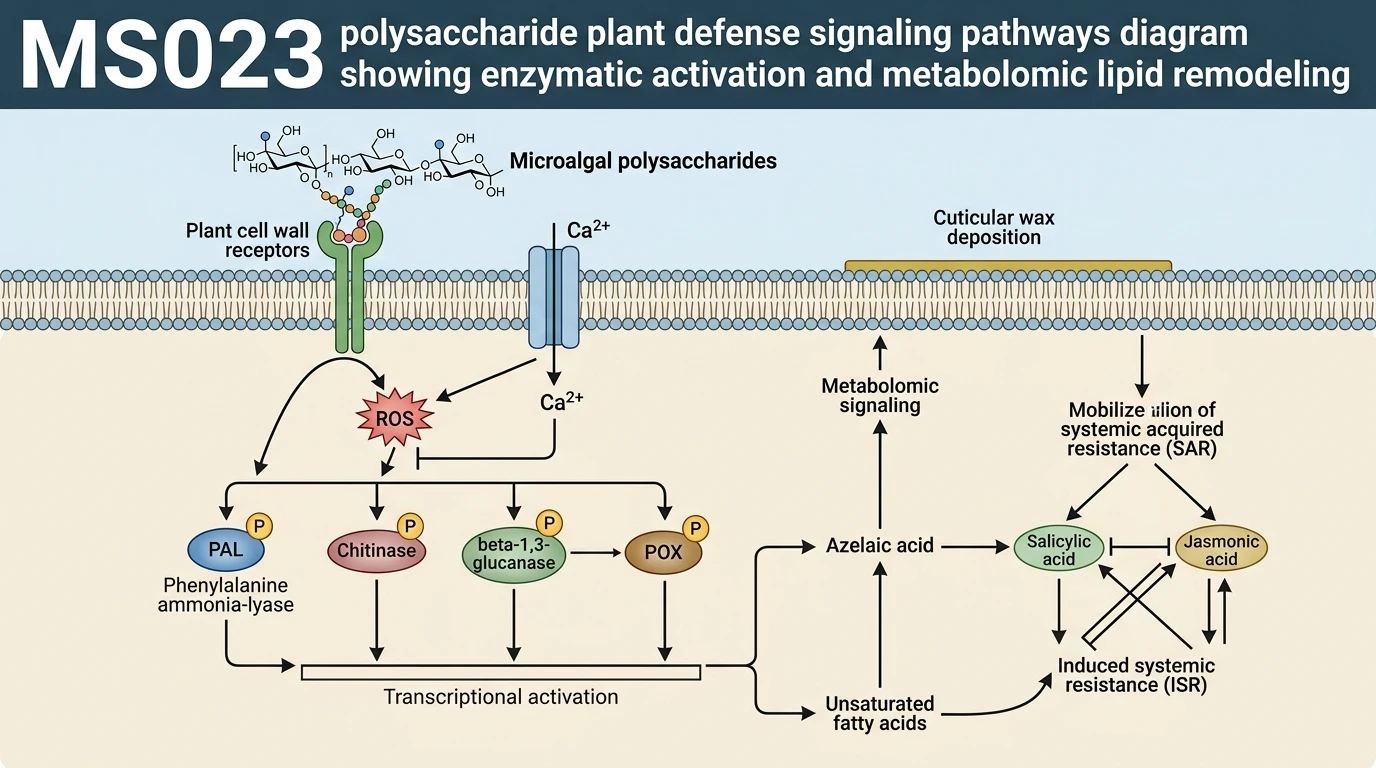
Exogenous biostimulants isolated from microalgal biomass represent a specialized class of biological elicitors capable of activating innate plant immunity. Polysaccharides purified from Phaeodactylum tricornutum strain MS023 demonstrate potent defense-eliciting activities when applied to foliar surfaces of tomato plants (Solanum lycopersicum). These complex carbohydrates—predominantly composed of sulfated beta-glucans—mimic structural motifs of microbial cell walls. Upon contact with the phyllosphere, MS023 polysaccharides bind specific pattern recognition receptors residing on the plant cell membrane. Receptor engagement triggers an immediate influx of extracellular calcium ions into the cytosol, accompanied by early depolarization of the plasma membrane. This intracellular ionic shift rapidly activates membrane-bound NADPH oxidases, known as respiratory burst oxidase homologs (RBOHs). The resulting transient oxidative burst produces localized reactive oxygen species, including superoxide radicals and hydrogen peroxide. These reactive oxygen species function not as destructive agents, but as secondary messengers within the cellular signaling network. Signal transduction proceeds through mitogen-activated protein kinase (MAPK) cascades, translating localized surface recognition into broad nuclear transcriptomic reprogramming. A primary metabolic response induced by MS023 involves substantial elevation of key defense-related enzymes. Phenylalanine ammonia-lyase (PAL), the enzyme catalyzing the initial non-oxidative deamination of L-phenylalanine to trans-cinnamic acid, exhibits an enzymatic activity increase of 238.26% relative to control groups. This dramatic upregulation accelerates downstream phenylpropanoid metabolism, channeling carbon flux toward the synthesis of phenolic compounds, flavonoids, and structural lignin. Concurrently, beta-1,3-glucanase enzymatic activity expands by 137.50%. This pathogenesis-related protein hydrolyzes fungal cell wall polymers, directly degrading structural glucans and releasing endogenous damage-associated molecular patterns (DAMPs) that further sustain immune activation. Parallel enzymatic monitoring demonstrates complementary upregulation of chitinase and peroxidase (POX) systems. Chitinase targets the beta-1,4-glycosidic bonds of fungal chitin, operating in functional synergy with beta-1,3-glucanase to compromise structural integrity in invading hyphae. Meanwhile, peroxidase activity drives the oxidative polymerization of hydroxycinnamyl alcohol monomers into cell wall lignin, while simultaneously cross-linking structural hydroxyproline-rich glycoproteins. This enzymatic hardening of the apoplastic matrix restricts pathogen penetration and limits localized cellular degradation. Gas chromatography-mass spectrometry (GC-MS) metabolomic analysis reveals that application of MS023 induces comprehensive lipid network remodeling in treated leaves. Quantified metabolic profiles confirm elevated biosynthesis of polyunsaturated fatty acids, notably hexadecatrienoic acid (C16:3), linoleic acid (C18:2), and alpha-linolenic acid (C18:3). These fatty acids serve as core substrates for lipoxygenase (LOX) enzymes, driving the oxylipin pathway toward jasmonate signaling molecules and volatile green leaf aldehydes. Metabolomic profiling highlights increased accumulation of azelaic acid, a nine-carbon dicarboxylic acid produced via oxidative cleavage of C18 unsaturated fatty acids. Azelaic acid functions as a systemic vascular signal, priming distant leaves for accelerated salicylic acid accumulation upon subsequent pathogen exposure. Simultaneously, enhanced synthesis of phytosterols—including beta-sitosterol and stigmasterol—modulates membrane fluidity and microdomain dynamics. Combined with increased cuticular wax precursors, this metabolic shift promotes dense wax crystal deposition across the leaf surface. These altered physical cuticular barriers decrease cuticle permeability, minimize water loss, and create a physical deterrent to pathogen appressorium formation. Through these integrated enzymatic and metabolomic alterations, MS023 coordinates cross-talk between salicylic acid-dependent systemic acquired resistance (SAR) and jasmonic acid-dependent induced systemic resistance (ISR) signaling pathways. The dual activation of physical barrier fortification and systemic biochemical defense provides durable protection against diverse phytopathogens under experimental growth conditions.
Metabolomic Restructuring and Enzymatic Defense Activation
Copy code to add this image to your page
MS023 polysaccharides act as biostimulants that trigger plant defense cascades in Solanum lycopersicum. Application significantly elevates phenylalanine ammonia-lyase (+238.26%) and beta-1,3-glucanase (+137.50%) activities along with chitinase and peroxidase. GC-MS profiles demonstrate altered lipid metabolomics, enriching unsaturated fatty acids, azelaic acid, and phytosterols to reinforce cuticular barriers while orchestrating salicylic acid- and jasmonic acid-mediated resistance.
Upregulation of Phenylalanine Ammonia-Lyase and Glucanase Enzymatic Activity
Foliar application of MS023 significantly enhances defensive enzyme kinetics in Solanum lycopersicum. Phenylalanine ammonia-lyase (PAL) activity increases by 238.26% within target leaf tissues under controlled greenhouse conditions. PAL serves as the gatekeeper enzyme for the phenylpropanoid biosynthetic pathway. Its activation drives carbon flux into phenolic compounds and structural lignin precursors. Downstream flux was confirmed by parallel increases in total phenolic content. Simultaneously, beta-1,3-glucanase activity exhibits a 137.50% increase. This pathogenesis-related enzyme cleaves fungal cell wall glucans directly. Secondary oxidative enzymes—specifically chitinase and peroxidase (POX)—also show elevated activities. Enhanced POX activity accelerates hydrogen peroxide-dependent cross-linking of cell wall structural proteins. Apoplastic matrix permeability drops following this structural reinforcement. These coordinated enzymatic responses establish a rapid biochemical barrier against pathogen invasion.
Cuticular Wax Accumulation and Systemic Resistance Signaling
GC-MS metabolomic profiling demonstrates extensive lipid profile alterations following MS023 treatment. Accumulation of key unsaturated fatty acids—specifically hexadecatrienoic acid (C16:3), linoleic acid (C18:2), and alpha-linolenic acid (C18:3)—increases markedly in leaf extracts. These fatty acids serve as substrates for oxylipin synthesis and cuticular wax formation. Epicuticular wax precursor levels rise substantially, reinforcing physical barrier properties on the leaf cuticle. Non-stomatal water loss decreases as cuticular density increases. Metabolomic tracking reveals elevated concentrations of azelaic acid and phytosterols. Azelaic acid functions as a vascular mobile signal required for priming systemic acquired resistance (SAR). This systemic signal coordinates with jasmonic acid- and salicylic acid-dependent pathways. Distal tissues maintain a primed defense state without observed yield penalties under tested experimental conditions.