6-Diazo-5-oxo-L-norleucine (Diazooxonorleucine) Covalently Inhibits Glutamine Metabolism in Cancer Cells
Copy code to add this image to your page
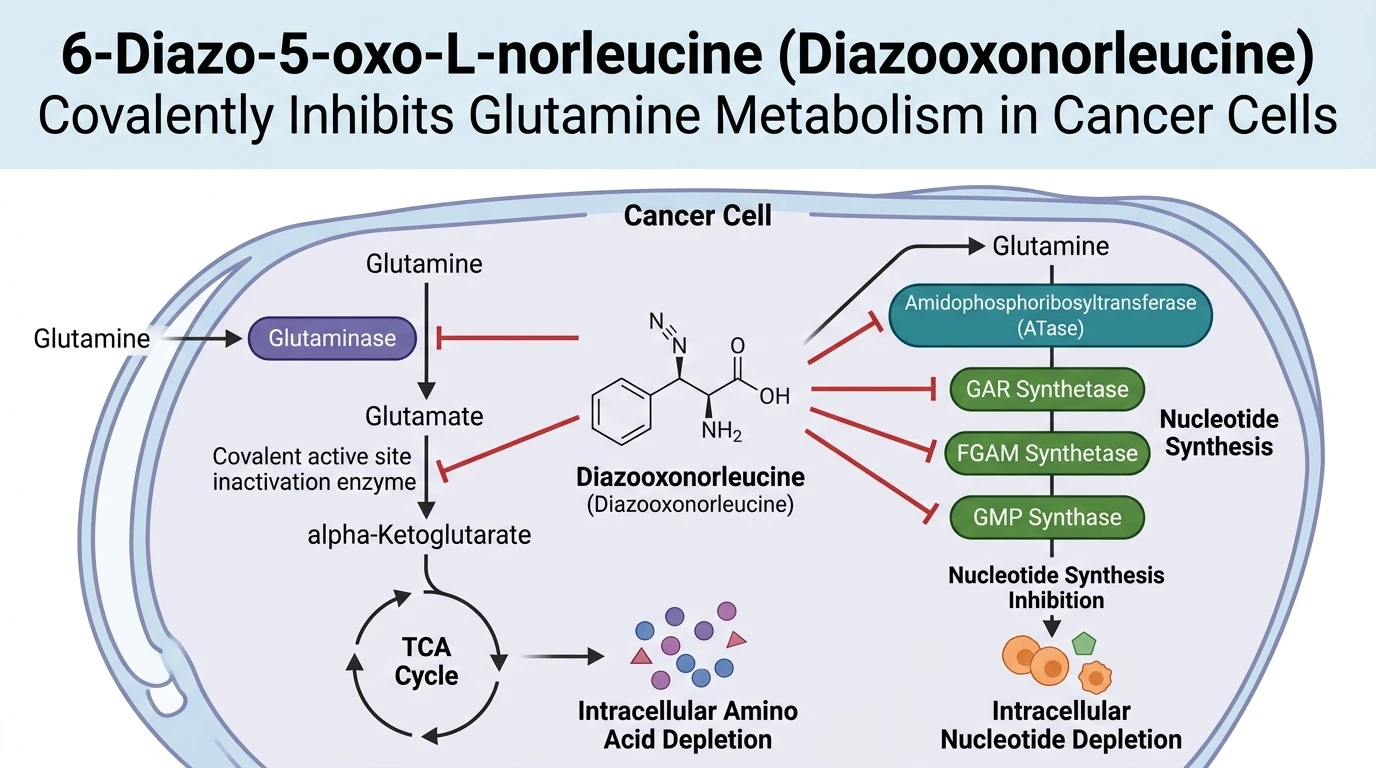
Structural mimicry of natural metabolic substrates represents a foundational strategy in target-directed antimetabolite design. The compound 6-Diazo-5-oxo-L-norleucine (Diazooxonorleucine), historically designated as DON, serves as a classic diazoketone derivative and L-glutamine antagonist. Structurally characterized by its terminal reactive diazo moiety and hexanoic acid backbone, the 6-Diazo-5-oxo-L-norleucine molecular profile enables competitive engagement with the substrate-binding pockets of glutamine-utilizing enzymes across multiple subcellular compartments.
Biochemically, glutamine serves as a critical nitrogen donor for anabolic reactions, including the synthesis of purine and pyrimidine nucleotides, non-essential amino acids, and hexosamines, alongside supporting mitochondrial oxidative phosphorylation via glutaminolysis. Within neoplastic tissues, elevated metabolic demands drive dependency on glutamine pathways. 6-Diazo-5-oxo-L-norleucine exploits this metabolic dependency through a dual-mechanism approach. First, it competes with endogenous L-glutamine for active site occupancy. Second, upon binding, the diazo group undergoes nucleophilic attack by conserved catalytic residues—typically cysteine or histidine residues within enzyme active centers—forming a covalent, irreversible adduct. This irreversible alkylation permanently inactivates key rate-limiting enzymes, including kidney-type glutaminase (GLS1), liver-type glutaminase (GLS2), phosphoribosylformylglycinamidine synthase (PFAS), cytidine triphosphate synthase (CTPS), and carbamoyl-phosphate synthetase 2, aspartate transcarbamylase, and dihydroorotase (CAD).
In vitro enzyme kinetic analyses demonstrate that inactivation of glutaminase by 6-Diazo-5-oxo-L-norleucine follows pseudo-first-order kinetics, exhibiting high target affinity with micromolar to sub-micromolar inhibition constants. In cellular assay systems, exposure to this agent leads to rapid depletion of intracellular glutamate and downstream tricarboxylic acid cycle intermediates, such as alpha-ketoglutarate, succinate, and malate. Concurrently, inhibition of PFAS and CTPS arrests de novo purine and pyrimidine biosynthesis, resulting in severe nucleotide pool imbalances, accumulation of pathway intermediates, and suppression of DNA and RNA synthesis. This combined metabolic blockade triggers energy stress, evidenced by a drop in cellular ATP/AMP ratios, activation of AMP-activated protein kinase (AMPK), and initiation of programmed cell death pathways.
Despite robust antineoplastic activity observed in preclinical models, historical clinical translation of native 6-Diazo-5-oxo-L-norleucine was limited by systemic toxicities, particularly severe gastrointestinal mucosal toxicity and nausea. These dose-limiting toxicities stem from off-target inhibition of glutamine-dependent processes in rapidly dividing intestinal epithelial cells. Consequently, contemporary research emphasizes targeted prodrug strategies, tumor-selective cleavage mechanisms, and combination approaches to widen the therapeutic window while preserving potent target engagement.
Covalent Glutamine Antagonism and Metabolic Cascade Inhibition
Copy code to add this image to your page
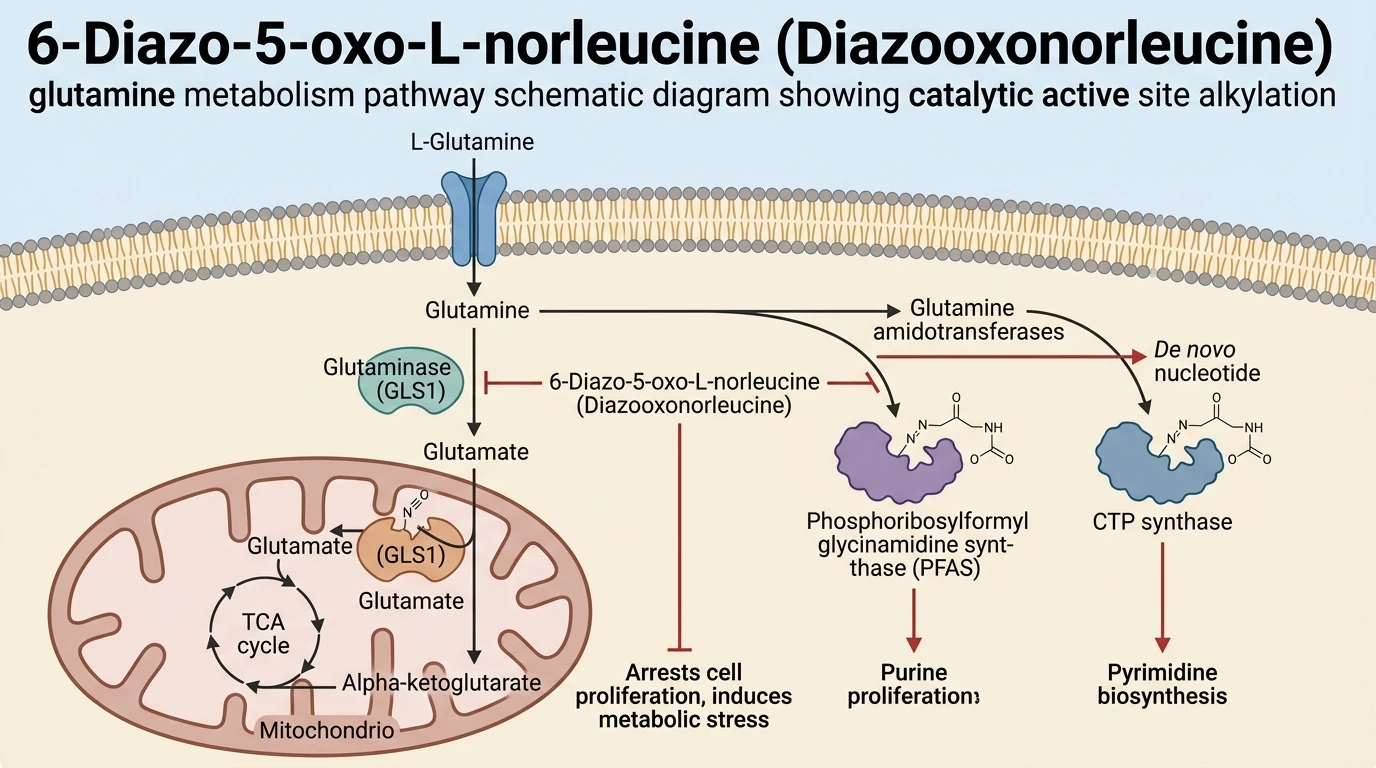
6-Diazo-5-oxo-L-norleucine functions as an irreversible glutamine antagonist. It mimics L-glutamine to bind the active sites of glutamine-utilizing enzymes, including glutaminase, CTP synthase, and phosphoribosylformylglycinamidine synthase. The reactive diazo group forms a covalent adduct with catalytic cysteine or nucleophilic residues in the enzyme catalytic pocket. This permanent inactivation shuts down glutaminolysis, halts de novo purine and pyrimidine biosynthesis, depletes intracellular ATP and NADPH pools, and blocks tumor cell proliferation.
Covalent Alkylation of Active Site Cysteine Residues in Glutaminase
Target engagement by 6-Diazo-5-oxo-L-norleucine relies on active site recognition within glutamine-utilizing enzymes. The catalytic core of glutaminase contains a conserved nucleophilic residue essential for amide hydrolysis. Upon entering the catalytic pocket, the compound positions its reactive diazo moiety adjacent to this nucleophile. Covalent bond formation occurs rapidly; the enzyme is permanently inactivated. In purified enzyme assays, inactivation kinetics confirm irreversible time-dependent inhibition. Substrate competition studies using excess L-glutamine attenuated alkylation rates. These kinetic parameters demonstrate classical mechanism-based enzyme inactivation.
Depletion of Nucleotide Pools Induces Autophagic Cell Death
Interruption of de novo purine and pyrimidine pathways triggers downstream metabolic stress. Cellular exposure to 6-Diazo-5-oxo-L-norleucine rapidly reduces intracellular GTP and CTP concentrations in human triple-negative breast cancer lines; nucleotide levels dropped significantly within six hours of administration. Deprived of essential building blocks, genomic replication halts at the S-phase checkpoint. Phosphorylation of histone H2AX increases, marking double-strand DNA damage. Simultaneously, activation of LC3-II indicates induction of protective autophagy. Prolonged nucleotide starvation eventually overrides autophagic adaptation; apoptotic cleavage of PARP confirms committed cell death.
Prodrug Modifications Mitigate Gastrointestinal Toxicity in Xenografts
Systemic exposure to unformulated glutamine antagonists causes intestinal epithelial damage. To circumvent systemic toxicity, gut-masked prodrug derivatives of 6-Diazo-5-oxo-L-norleucine were evaluated in murine xenograft models. Tumor-selective cleavage enzymes liberate active drug preferential inside neoplastic tissue. Plasma concentration profiles showed reduced peak toxicity levels while tumor tissue drug accumulation remained elevated. Treated xenografts demonstrated sustained tumor growth inhibition without significant body weight loss. Histological examination of intestinal crypts confirmed preserved mucosal architecture.