Futibatinib (TAS-120) TAS-120 FGFR inhibitor Irreversible Kinase Blockade in Advanced Cholangiocarcinoma
Copy code to add this image to your page
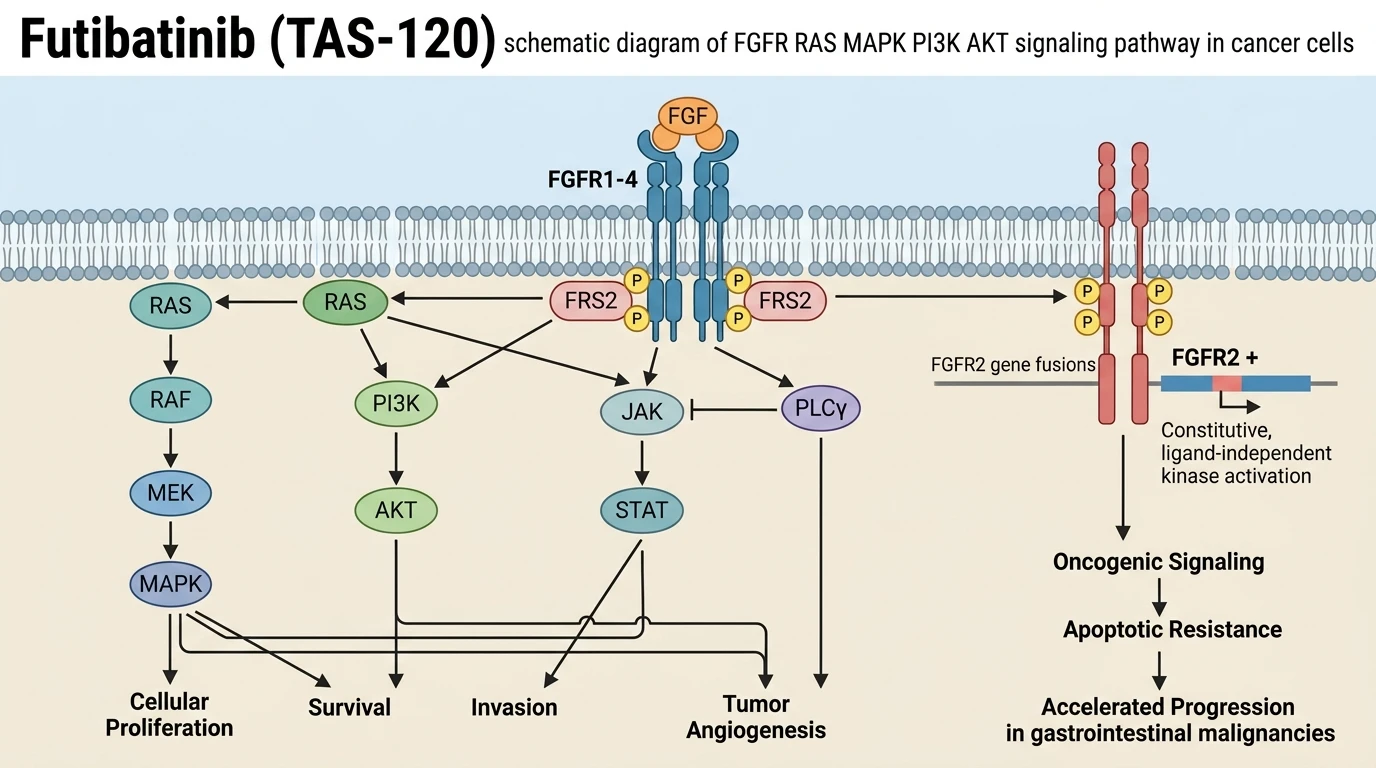
Fibroblast growth factor receptor (FGFR) signaling plays a prominent role in driving cellular proliferation, survival, and tissue homeostasis. The receptor tyrosine kinase family encompasses four highly conserved transmembrane receptors, designated FGFR1 through FGFR4. Upon activation by extracellular fibroblast growth factors, these receptors undergo conformational rearrangement, leading to homodimerization and trans-autophosphorylation of intracellular tyrosine kinase domains. Downstream intracellular signaling cascades are subsequently mobilized through key adaptor proteins such as FGFR substrate 2 (FRS2). Primary downstream pathways include the RAS-Raf-MEK-ERK (RAS-MAPK) pathway, the PI3K-AKT-mTOR network, the JAK-STAT axis, and the phospholipase C gamma (PLCγ) pathway. Dysregulation of these pathways through gene amplifications, point mutations, or chromosomal rearrangements promotes malignant cell transformation, metastatic colonization, and therapeutic resistance across various solid tumors.
In intrahepatic cholangiocarcinoma (iCCA), genomic profiling frequently reveals structural rearrangements resulting in oncogenic FGFR2 fusions. These genetic fusions preserve the functional intracellular kinase domain while joining it with various amino-terminal fusion partners, inducing constitutive, ligand-independent receptor dimerization and continuous downstream signaling. While first-generation ATP-competitive, reversible pan-FGFR inhibitors have demonstrated clinical activity, their efficacy is consistently limited by the rapid emergence of secondary target mutations. Mutational alterations within the FGFR kinase domain—most notably gatekeeper residue substitutions such as FGFR2 V565I/L/F and activation loop mutations—sterically hinder drug binding or alter ATP affinity, leading to treatment failure in patient populations.
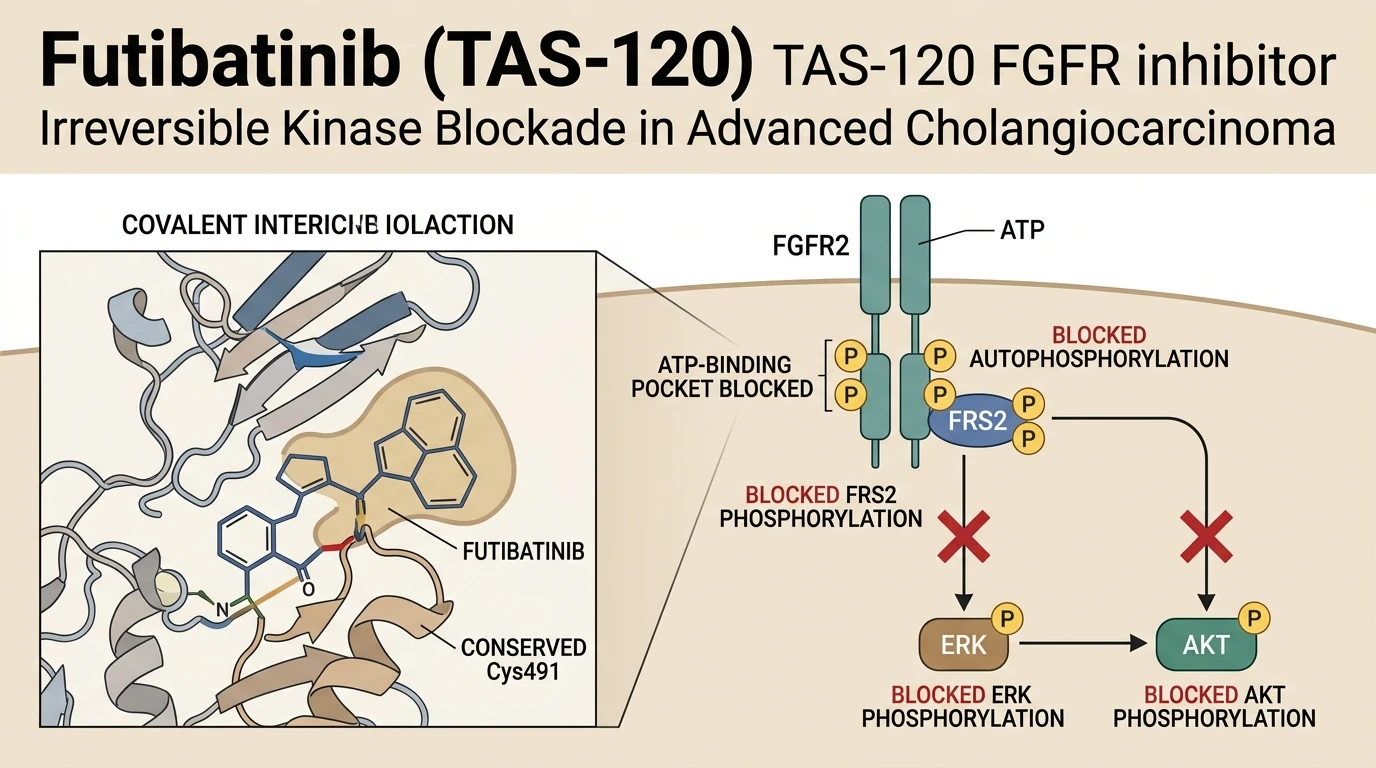
To address these mechanism-based resistance profiles, small-molecule drug design shifted toward covalent active-site targeting. Futibatinib (TAS-120) was engineered as an oral, potent, highly selective, covalent irreversible pan-FGFR (FGFR1–4) kinase inhibitor. Structurally, the compound features an acrylamide warhead capable of forming a specific, irreversible covalent adduct with a conserved cysteine residue (Cys491 in FGFR2) located within the ATP-binding pocket of the kinase domain. Unlike reversible FGFR inhibitors that depend on constant, concentration-dependent active-site occupancy, covalent binding by Futibatinib (TAS-120) induces persistent target inactivation that persists until new receptor protein is synthesized. This distinct binding kinetics endows the molecule with enhanced potency against wild-type FGFR isoforms as well as an array of secondary resistance mutations acquired during prior therapy with reversible kinase inhibitors.
Preclinical biochemistry and structural biology studies confirm that covalent engagement by the TAS-120 FGFR inhibitor effectively shuts down autophosphorylation of FGFR1, FGFR2, FGFR3, and FGFR4 at low nanomolar concentrations. Biochemical assays performed under physiological ATP conditions demonstrate sustained target occupancy. In cell line models expressing wild-type or mutated FGFR constructs, treatment leads to rapid extinction of phospho-FRS2, phospho-ERK1/2, and phospho-AKT levels. Consequently, cell cycle arrest is induced, and apoptotic execution pathways are triggered within hours of drug contact.
Translational and clinical evaluation of futibatinib has centered primarily on advanced intrahepatic cholangiocarcinoma harboring FGFR2 gene fusions or structural rearrangements. In early-phase clinical investigations, including the pivotal FOENIX-101 and FOENIX-CCA2 trials, futibatinib exhibited substantial antineoplastic activity in patients with refractory disease. Objective overall response rates (ORR) reached approximately 37%, accompanied by disease control rates (DCR) exceeding 80% in FGFR2 fusion-positive cohorts. Remarkably, clinical efficacy extended to patients whose tumors harbored secondary FGFR2 resistance mutations following disease progression on reversible FGFR inhibitors. The compound maintained a manageable safety profile characterized primarily by on-target hyperphosphatemia, dermatologic changes, and gastrointestinal adverse events, which were mitigated through proactive dose management strategies. Ongoing Phase III trials are evaluating futibatinib as a frontline systemic monotherapy in comparison to standard gemcitabine plus cisplatin chemotherapy regimens.
Pharmacological Characterization and Clinical Performance
Copy code to add this image to your page
Futibatinib (TAS-120) is an oral, highly selective, covalent irreversible pan-FGFR (FGFR1–4) inhibitor. It forms a durable covalent bond with a specific conserved cysteine residue within the ATP-binding pocket of the kinase domain. This permanent engagement prevents ATP hydrolysis and autophosphorylation, blocking downstream RAS-MAPK, PI3K-AKT, JAK-STAT, and PLCγ signaling pathways. Through its covalent mechanism, futibatinib maintains potent kinase inhibition against both wild-type FGFR receptors and secondary gatekeeper or activation loop mutations that mediate clinical resistance to reversible FGFR inhibitors.
Irreversible Binding Overcomes Gatekeeper and Activation Loop Resistance
The structural basis for the activity of futibatinib lies in its targeted covalent kinetic mechanism. Reversible inhibitors dissociate rapidly from the ATP-binding pocket when intracellular ATP levels fluctuate or when point mutations alter steric binding parameters. In contrast, the acrylamide motif of the TAS-120 FGFR inhibitor establishes a durable covalent bond with Cys491 in FGFR2. Target residence time is markedly prolonged. In cell line models expressing common gatekeeper mutations such as FGFR2 V565I, the drug maintains low nanomolar inhibitory activity. Kinase autophosphorylation stopped almost entirely in treated lysates. Downstream ERK phosphorylation was suppressed sustainedly over 48 hours. By occupying the ATP pocket irreversibly, the molecule minimizes drug-free target duration, preventing re-activation of the RAS-MAPK cascade.
Sustained Antitumor Efficacy in FOENIX-CCA2 Clinical Evaluation
The phase 2 FOENIX-CCA2 trial established the clinical efficacy of futibatinib in patients with FGFR2 fusion-positive unresectable or metastatic intrahepatic cholangiocarcinoma. Patients receiving 24 mg once daily experienced an overall response rate of 37.3%. Tumor regression occurred consistently across diverse fusion partner subtypes. Median duration of response reached 9.7 months in the trial cohort. Disease control was maintained in 82.5% of enrolled individuals. The TAS-120 FGFR inhibitor demonstrated activity in patients with prior treatment failure on reversible FGFR inhibitors, confirming cross-resistance bypass in clinical settings. Adverse event management required frequent hyperphosphatemia monitoring; however, treatment discontinuation rates due to toxicity remained low.