UNC0642 from Selleck Inhibits G9a/GLP to Attenuate Alcohol Drinking in Murine Dependence Models
Copy code to add this image to your page
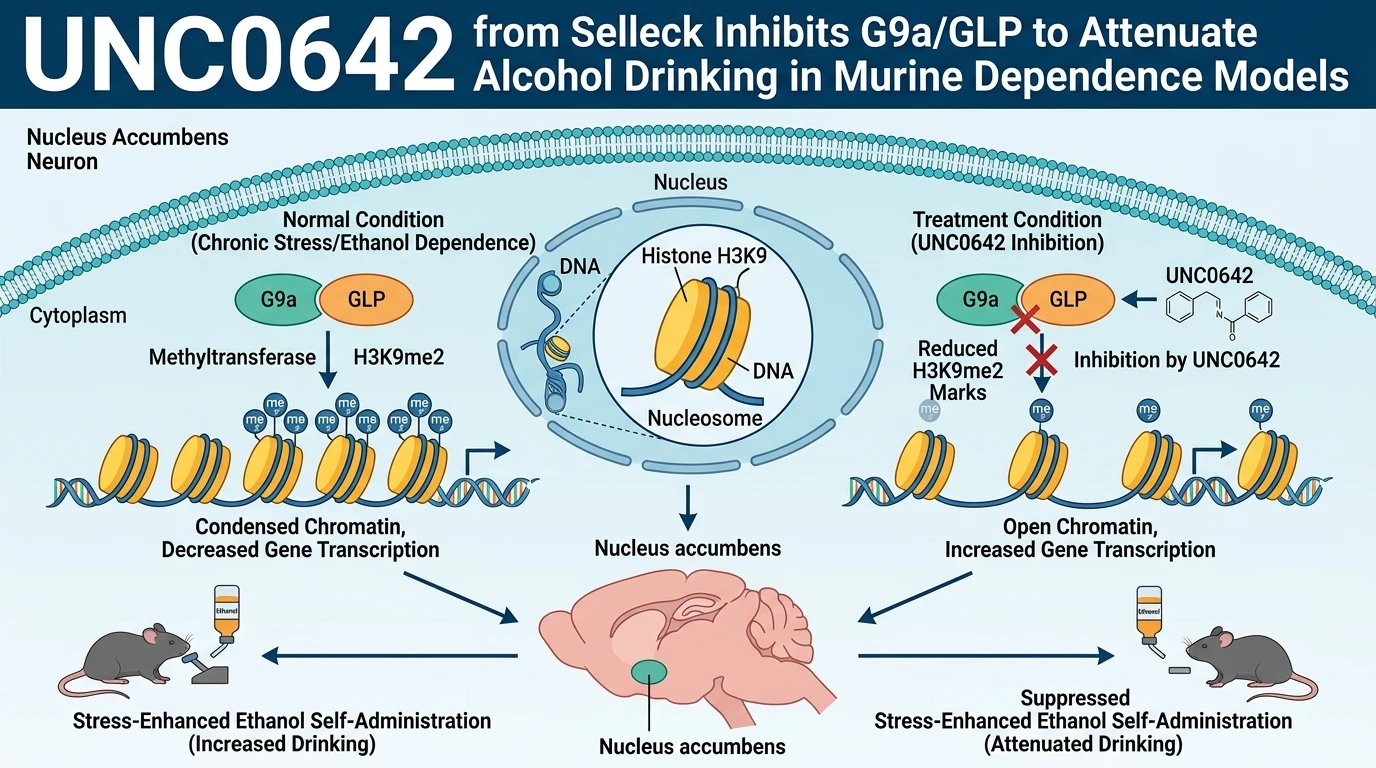
Chromatin modification within mesolimbic reward circuitry governs enduring behavioral adaptations associated with chronic substance exposure. Euchromatic histone-lysine N-methyltransferase 2 (EHMT2, designated G9a) and its obligate heterodimerization partner EHMT1 (GLP) function as primary enzymes catalyzing histone H3 lysine 9 dimethylation (H3K9me2). This specific epigenetic modification enforces transcriptional silencing across gene networks involved in synaptic reorganization and neuronal reactivity. Epigenetic reprogramming within the nucleus accumbens (NAc) mediates neuroadaptations driven by chronic ethanol intake and concurrent stress exposure.
Targeting epigenetic machinery provides a mechanistic strategy to interrupt neurobiological escalation of substance use. Investigation of G9a/GLP catalytic activity within murine paradigms of ethanol exposure clarifies the contribution of H3K9me2 modification to excessive drinking behaviors. Experimental designs combining chronic intermittent ethanol exposure with forced swim stress (CIE + FSS) model the interaction between physical ethanol dependence and acute stress challenges. Within this preclinical framework, elevated ethanol self-administration reflects both neuroadaptations induced by physical withdrawal and stress-triggered potentiated consumption.
Sustained viral-mediated knockdown of G9a localizing specifically to medium spiny neurons within the NAc selectively abolishes stress-potentiated escalation of ethanol consumption. Quantitative behavioral evaluations confirm that NAc-specific G9a depletion suppresses intake in animals subjected to CIE + FSS protocols. Critically, baseline ethanol consumption in non-dependent control mice remains unchanged following intra-NAc viral delivery. Secondary behavioral parameters—including total daily water intake and sucrose preference metrics—demonstrate no alteration, confirming that G9a knockdown does not induce generalized anhedonia, motor impairment, or nonspecific fluid disruption.
Pharmacological validation of these genetic findings utilizes medicinal chemistry insights into epigenetic modulation via UNC0642, a potent, selective, substrate-competitive small molecule inhibitor of G9a and GLP. UNC0642 exhibits sub-nanomolar enzymatic potencies (IC50 < 2.5 nM) and significant selectivity against broader methyltransferase panels. Crucially, the compound displays exceptional central nervous system penetration following systemic administration, achieving pharmacologically relevant concentration profiles in brain tissue.
Systemic administration of UNC0642 across repeated dosing schedules significantly attenuates elevated ethanol consumption in both dependence-induced (CIE-alone) and stress-enhanced (CIE + FSS) preclinical cohorts. Reductions in daily ethanol intake occur without compromising motor performance or altering blood alcohol concentration (BAC) clearance kinetics. The compound produces no measurable impact on baseline ethanol drinking in non-dependent control animals, delineating a clear functional boundary: G9a/GLP inhibition selectively rescues aberrantly elevated drinking states without disrupting unconditioned primary reinforcement or homeostatic drive. Epigenetic target engagement assays confirm marked reductions in nuclear H3K9me2 levels in NAc lysate preparations isolated from treated rodents. Consequently, small molecule inhibition of G9a/GLP enzymatic activity uncouples stress adaptation mechanisms from escalation pathways in models of alcohol use disorder.
Pharmacological Characterization and Epigenetic Target Engagement
Copy code to add this image to your page
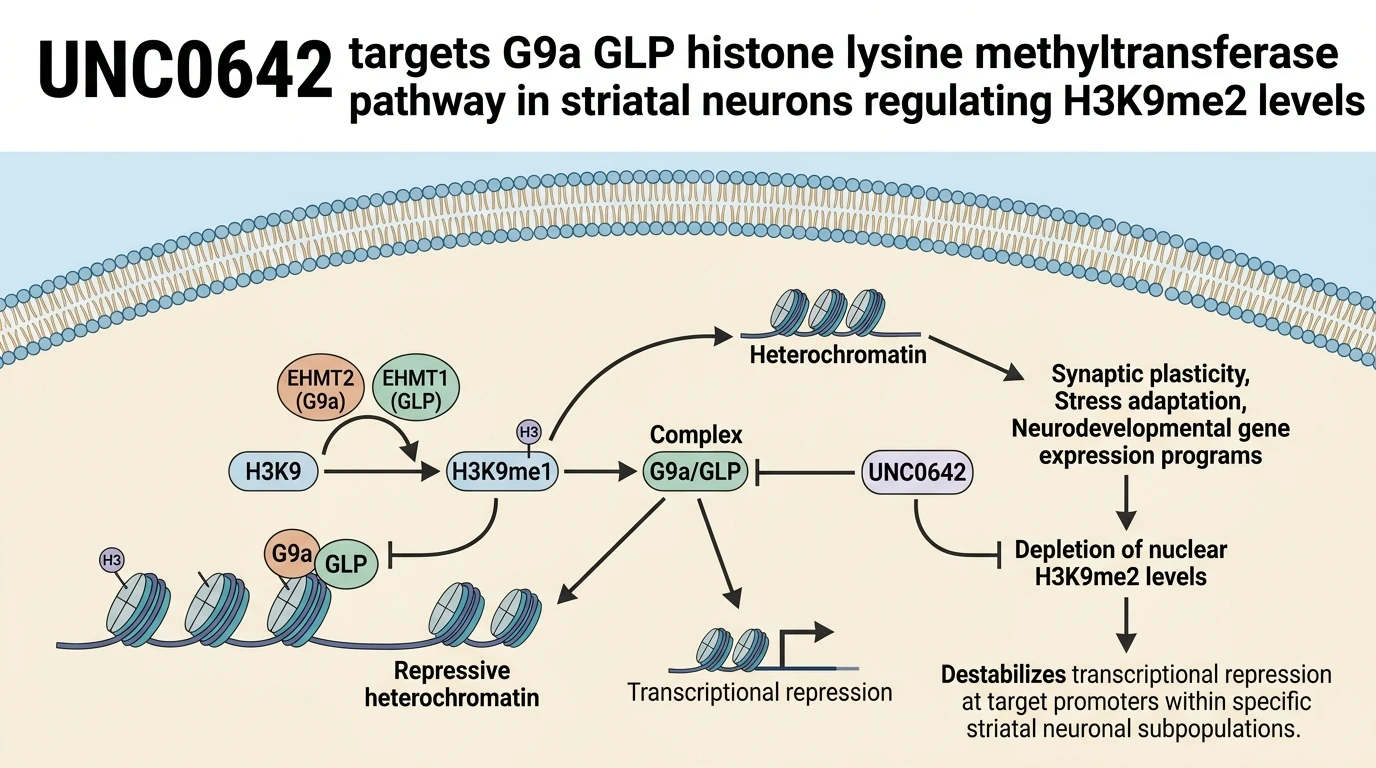
UNC0642 acts as a selective, brain-permeable substrate-competitive inhibitor of G9a (EHMT2) and GLP (EHMT1) histone methyltransferases. By blocking enzymatic mono- and dimethylation of histone H3 at lysine 9 (H3K9me2) within nucleus accumbens neurons, UNC0642 disrupts transcriptional repressor complexes involved in neuroadaptation to physical ethanol dependence and forced swim stress. In vivo administration attenuates both dependence-driven and stress-enhanced alcohol intake in mouse models without modifying baseline fluid intake, sucrose preference, or systemic ethanol clearance rates.
G9a Knockdown in Nucleus Accumbens Blocked Stress-Induced Drinking
Epigenetic remodeling inside the nucleus accumbens regulates stress reactivity. Viral vector delivery of short hairpin RNA targeting G9a selectively depleted local EHMT2 expression within the NAc shell and core microcircuits. In non-dependent control rodents, intra-NAc G9a silencing produced no significant shift in baseline ethanol intake. Total daily fluid intake remained stable. However, when animals underwent chronic intermittent ethanol vapors combined with forced swim stress challenges, control groups escalated ethanol consumption markedly. Knockdown of G9a completely prevented this stress-potentiated drinking surge. Sucrose preference values remained unaltered across all testing blocks. These data indicate that NAc G9a activity specifically mediates stress-induced behavioral escalation without compromising general reward processing or baseline drinking drives.
Systemic Administration of UNC0642 Suppressed Dependence Escalation
Small-molecule targeting of G9a/GLP recapitulates genetic silencing phenotypes. Utilizing high-purity UNC0642 from Selleck, researchers evaluated systemic intraperitoneal dosing regimes in dependence models. Subnanomolar catalytic inhibition decreased nuclear H3K9me2 concentration within striatal tissue. The drug crossed the blood-brain barrier efficiently. In CIE-exposed mice exhibiting marked ethanol dependence, repeated daily treatment with UNC0642 from Selleck significantly attenuated ethanol consumption. The suppression persisted throughout the stress-potentiated drinking phase. Importantly, non-dependent control animals exhibited no alteration in ethanol intake following equivalent drug administration. Plasma pharmacokinetics confirmed that blood alcohol elimination rates were unaffected by drug exposure. The compound selectively targets hyper-activated epigenetic states without impairing basal metabolic function.