INCB054828 (Pemigatinib) Selectively Inhibits FGFR Kinase Activity and Suppresses Downstream Oncogenic Signaling
Copy code to add this image to your page
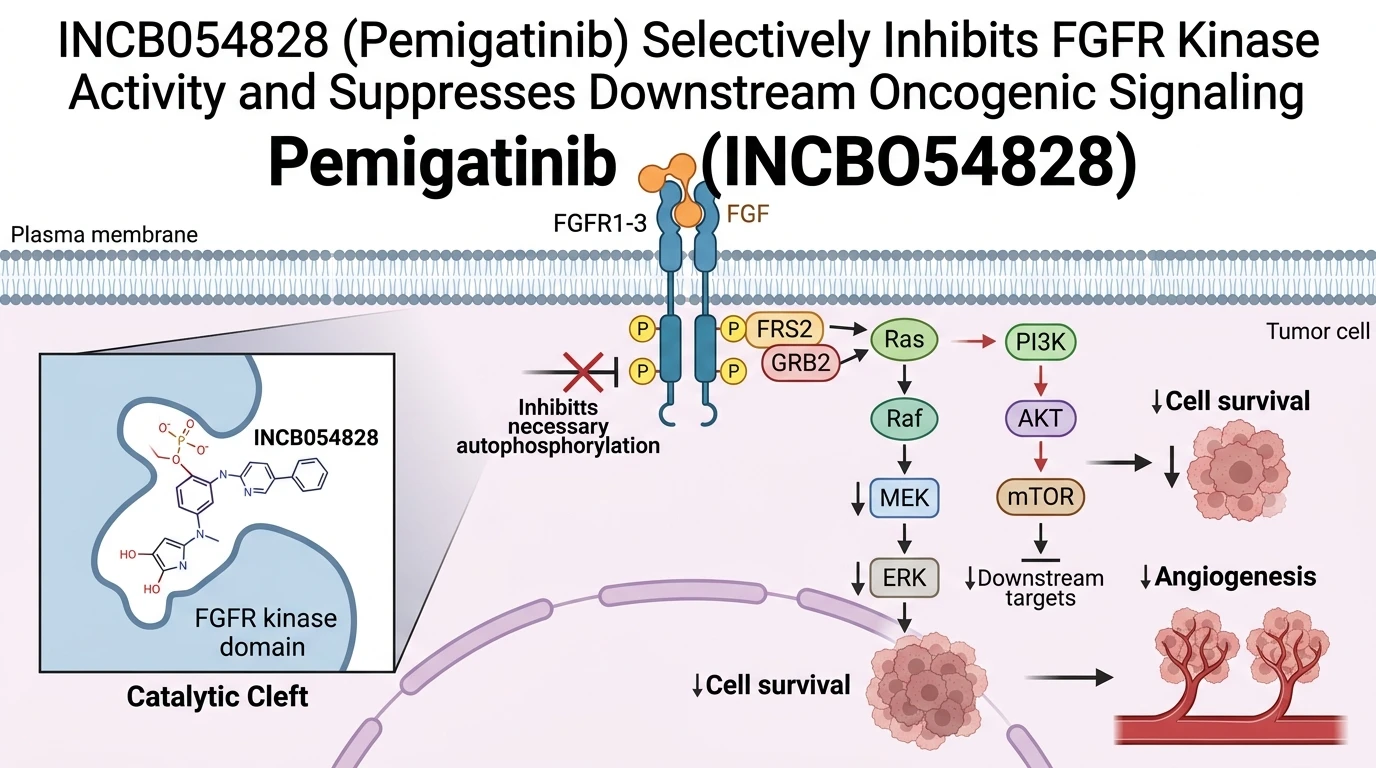
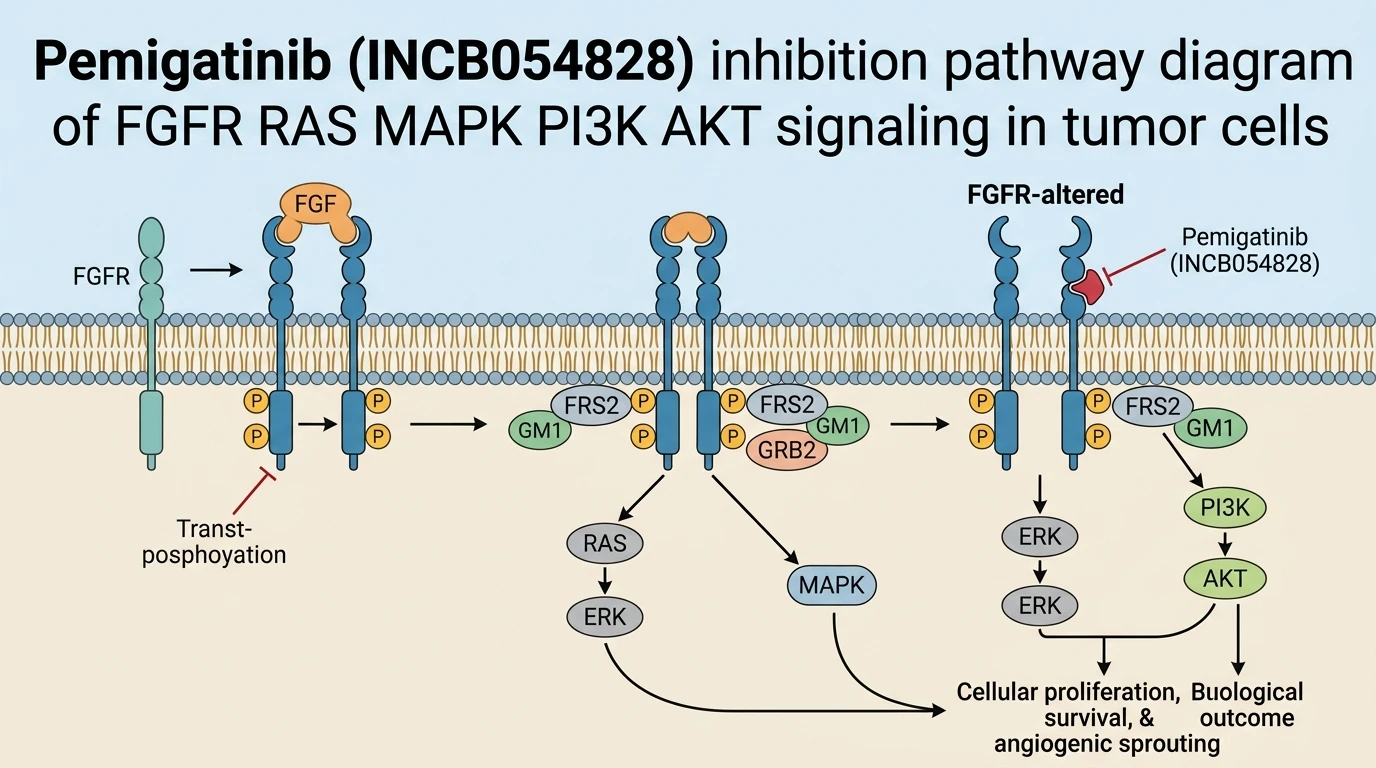
Fibroblast growth factor receptor (FGFR) signaling governs essential physiological processes including embryogenesis, tissue homeostasis, and vascular development. The FGFR family comprises four highly conserved transmembrane receptor tyrosine kinases (FGFR1-4) that bind extracellular FGF ligands in complex with heparin sulfate glycosaminoglycans. Ligand engagement triggers receptor dimerization, inducing transphosphorylation of specific tyrosine residues within the catalytic domain. Activated FGFRs recruit docking proteins such as fibroblast growth factor receptor substrate 2 (FRS2) and growth factor receptor-bound protein 2 (GRB2), establishing a scaffolding complex that initiates downstream signal transmission.
Downstream signal propagation proceeds predominantly through two major intracellular cascades: the mitogen-activated protein kinase (RAS-MAPK) pathway and the phosphatidylinositol 3-kinase (PI3K-AKT) pathway. Phosphorylated FRS2 activates the guanine nucleotide exchange factor SOS, which subsequently converts inactive RAS-GDP to active RAS-GTP. Sequential phosphorylation of RAF, MEK, and ERK follows, resulting in nuclear translocation of ERK and activation of transcription factors that promote cell cycle progression. Concurrently, activation of PI3K converts phosphatidylinositol 4,5-bisphosphate (PIP2) to phosphatidylinositol 3,4,5-trisphosphate (PIP3), creating binding sites for AKT and PDK1. AKT phosphorylation promotes cell survival by inhibiting pro-apoptotic targets.
Aberrant FGFR signaling—arising from gene amplifications, point mutations, or chromosomal translocations—acts as a primary oncogenic driver in multiple solid tumors. Chromosomal rearrangements involving FGFR2 are observed in approximately 10% to 15% of patients with intrahepatic cholangiocarcinoma. These fusions yield constitutively active, ligand-independent chimeric receptor kinases that continuously stimulate RAS-MAPK and PI3K-AKT cascades, promoting uncontrolled cell proliferation, survival, and tumor angiogenesis.
Pemigatinib (INCB054828) was identified as a potent, selective, ATP-competitive small-molecule inhibitor of FGFR isoforms 1, 2, and 3. In cell-free biochemical assays, INCB054828 demonstrated single-digit nanomolar potency, exhibiting IC50 values of 0.4 nM for FGFR1, 0.5 nM for FGFR2, and 1.0 nM for FGFR3. By contrast, its inhibitory activity against FGFR4 is markedly reduced (IC50 = 16.5 nM), reflecting subtle structural differences within the FGFR4 ATP-binding pocket. Recombinant enzyme kinetics indicate that INCB054828 reversibly occupies the catalytic cleft, preventing ATP binding and subsequent transphosphorylation of the activation loop.
In cellular models harboring FGFR alterations, treatment with Pemigatinib (INCB054828) results in rapid concentration-dependent suppression of FGFR autophosphorylation. Interruption of receptor phosphorylation prevents the recruitment of FRS2, leading to a marked decrease in phosphorylated ERK1/2 and phosphorylated AKT levels. In vitro proliferation assays show that INCB054828 selectively impairs the growth of FGFR-dependent cell lines while exerting minimal effect on cells lacking FGFR abnormalities. In vivo studies using patient-derived xenograft (PDX) models of FGFR2-fusion intrahepatic cholangiocarcinoma demonstrated significant tumor regression alongside decreased microvessel density, confirming anti-angiogenic activity.
Despite target selectivity, therapeutic inhibition of FGFR signaling alters homeostatic regulatory axes. FGF23 signaling through FGFR1 and its coreceptor alpha-Klotho in renal proximal tubules normally suppresses renal phosphate reabsorption. Kinase inhibition by INCB054828 disrupts this pathway, producing hyperphosphatemia as a primary, mechanism-based pharmacodynamic marker. Additional toxicities observed in clinical evaluation include stomatitis, diarrhea, alopecia, palmar-plantar erythrodysesthesia, and serous retinopathy. Clinical management strategies—utilizing dietary phosphate restriction, oral phosphate binders, and targeted dose modifications—allow control of these adverse events while maintaining therapeutic target engagement.
Pharmacological Characterization and Target Engagement Profiles
Copy code to add this image to your page
Pemigatinib (INCB054828) is a potent, ATP-competitive small-molecule inhibitor of FGFR isoforms 1, 2, and 3. By selectively binding to the intracellular kinase domain, INCB054828 prevents receptor autophosphorylation and subsequent assembly of FRS2/GRB2 signaling complexes. This molecular blockade interrupts downstream signal transmission through both the RAS-MAPK and PI3K-AKT pathways. Consequently, cellular proliferation, survival, and tumor-associated angiogenesis are suppressed in FGFR-driven malignancies.
Potent Isoform-Selective Kinase Inhibition in Biochemical Assays
Biochemical evaluation reveals that INCB054828 functions as an ATP-competitive inhibitor with sub-nanomolar to nanomolar affinity across FGFR1-3. In enzymatic kinase assays, IC50 values were established at 0.4 nM for FGFR1, 0.5 nM for FGFR2, and 1.0 nM for FGFR3. Inhibitory potency against FGFR4 was significantly lower (IC50 = 16.5 nM). Selectivity profiling against a panel of over 200 non-FGFR kinases demonstrated minimal off-target activity at physiological concentrations. Kinetic analysis indicated rapid target association with sustained residence time on the FGFR2 catalytic domain. Phospho-proteomic profiling confirmed that intracellular phosphorylation of FRS2 and downstream ERK1/2 decreased markedly within one hour of treatment in cell lines harboring FGFR2-BICC1 fusions. These findings confirm high specificity for FGFR1-3 isoforms.
In Vivo Tumor Regression and Angiogenesis Suppression
In mouse xenograft models derived from FGFR2-fusion cholangiocarcinoma cell lines, oral administration of INCB054828 induced significant, dose-dependent tumor growth inhibition. Plasma exposure levels correlated directly with suppression of phosphorylated ERK in harvested tumor lysates. At target therapeutic doses, tumor regression was accompanied by reduced endothelial vessel density. Cellular apoptosis markers, including cleaved caspase-3, increased significantly within 48 hours of initial exposure. In parallel non-clinical safety studies, hyperphosphatemia emerged as a consistent off-target physiological consequence of FGFR1 inhibition in renal tubular epithelia. Serum phosphate concentration increases mirrored drug exposure profiles, providing an accessible biomarker of target engagement in preclinical models.
Management of Pharmacodynamic Toxicities in Patient Cohorts
Clinical studies evaluating Pemigatinib in patients with previously treated, unresectable or metastatic intrahepatic cholangiocarcinoma carrying FGFR2 fusions confirmed antitumor efficacy. Hyperphosphatemia occurred in most subjects, reflecting target engagement of FGFR1 in the kidney. Interventions including low-phosphate diets and oral phosphate-lowering agents effectively mitigated serum phosphate elevations. Dermatological toxicities and serous retinopathy were routinely managed via protocol-defined dose interruptions or adjustments. Overall, proactive monitoring allowed sustained therapeutic dosing while maintaining clinical safety profiles across patient cohorts.