Ravoxertinib (GDC-0994) Targets ERK1/2 Kinase Signal Cascade in CircRNA-Regulated Gastric Cancer Models
Copy code to add this image to your page
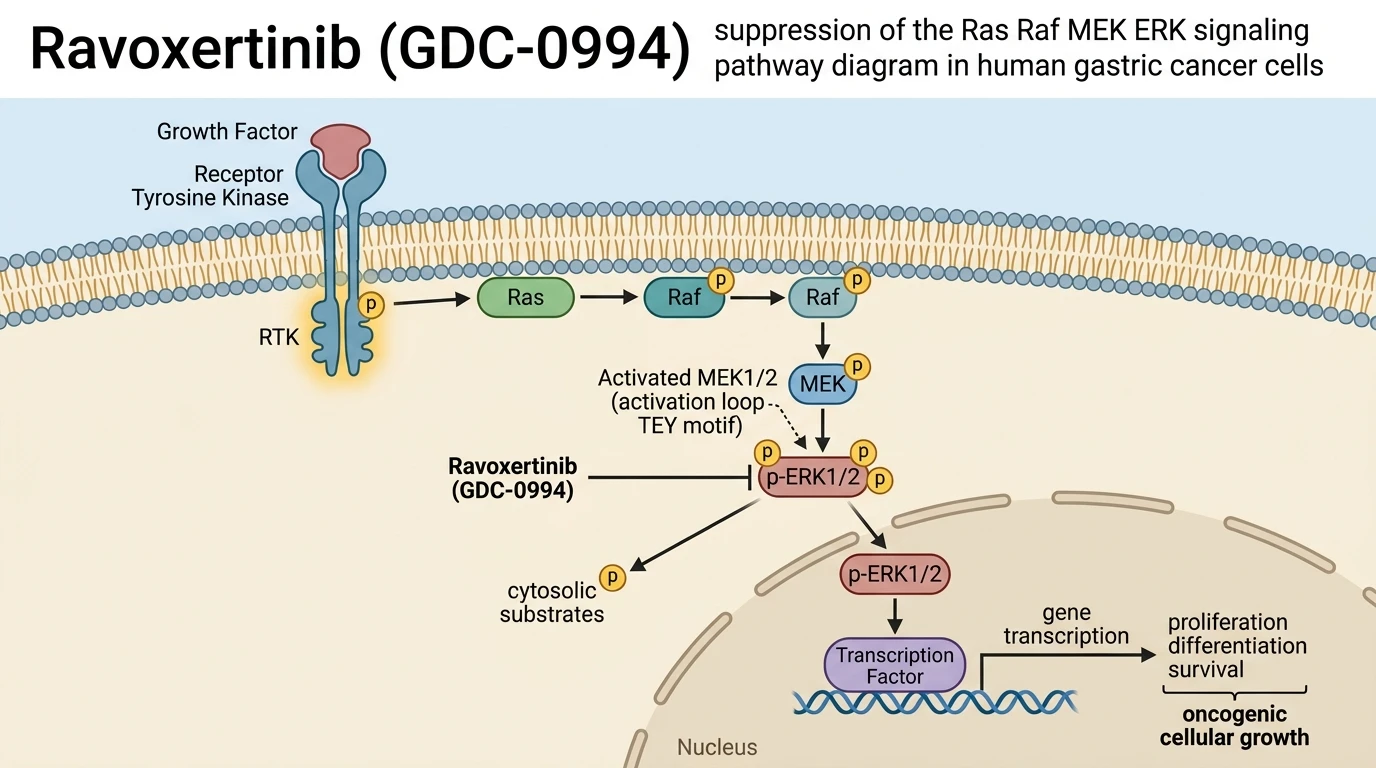
Aberrant activation of the MAPK signaling cascade drives malignant phenotypes across human gastrointestinal malignancies. Within this canonical cascade, extracellular signal-regulated kinase 1 and 2 (ERK1/2) operate as terminal enzymatic hubs. These serine/threonine kinases transduce upstream phosphorylation events into nuclear transcriptional programs controlling cellular cycle progression, motility, and survival. Small-molecule inhibition of ERK1/2 represents a targeted pharmacological approach to arrest downstream signaling in tumors driven by upstream alterations. Ravoxertinib (GDC-0994) is an orally bioavailable, highly selective small-molecule inhibitor designed to engage the ATP-binding pocket of ERK1/2. Pharmacological evaluation reveals that GDC-0994 binds reversibly to active and inactive ERK isoforms, suppressing downstream substrate phosphorylation without perturbing upstream MEK activation kinetics.
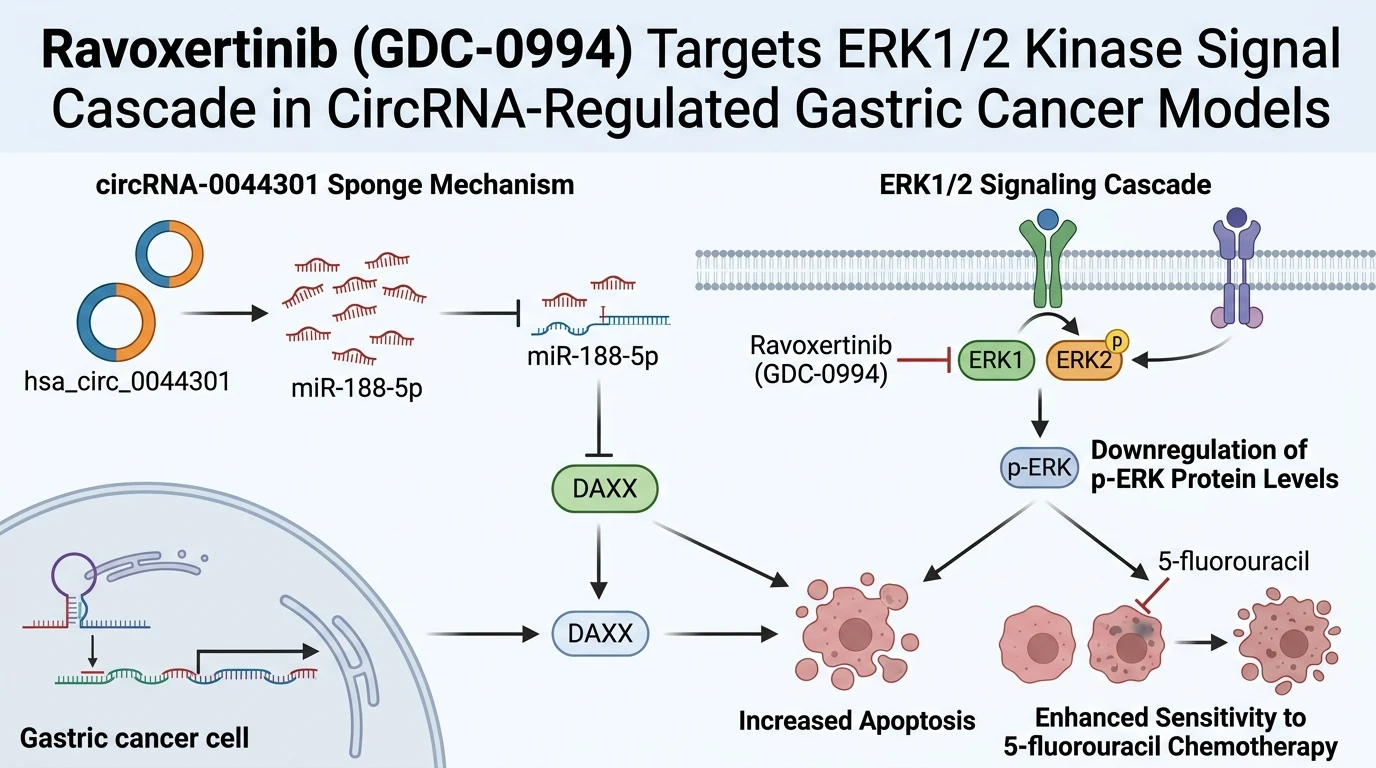
Recent transcriptomic profiling in gastric adenocarcinoma reveals a multi-tiered regulatory network involving non-coding RNAs that modulates baseline MAPK activation state. Specifically, human circular RNA hsa_circ_0044301 exhibits marked upregulation in primary gastric tumor tissues compared to adjacent non-neoplastic mucosa. Mechanistic dissection demonstrates that hsa_circ_0044301 acts as an endogenous microRNA sponge. By sequestering hsa-miR-188-5p, circRNA-0044301 derepresses the expression of Death Domain-Associated Protein (DAXX). Elevated DAXX expression subsequently drives MAPK signaling flux, elevating baseline levels of phosphorylated ERK1/2 (p-ERK1/2) and sustaining cellular proliferation and invasive cellular migration.
At the structural level, GDC-0994 occupies the ATP-binding cleft of ERK1 and ERK2 with low-nanomolar binding affinity. This competitive occupancy prevents the transfer of the gamma-phosphate group from ATP to downstream target substrates, including p90 ribosomal S6 kinase (p90RSK), ETS domain-containing protein Elk-1, and c-Fos. In conventional cancer models, sustained inhibition of ERK1/2 triggers compensatory upstream activation of MEK via loss of negative feedback loops. However, in gastric cancer cells overexpressing circRNA-0044301, DAXX accumulation independently reinforces MAPK cascade activation downstream of receptor tyrosine kinases. The sponging of hsa-miR-188-5p by circRNA-0044301 prevents microRNA-mediated degradation of DAXX mRNA, leading to sustained DAXX protein accumulation.
Genetic ablation of circRNA-0044301 via specific small interfering RNA oligonucleotides significantly alters the biochemical baseline of gastric cancer cell lines. Loss-of-function studies utilizing short interfering RNA vectors directed against circRNA-0044301 demonstrate a direct reduction in both total ERK1/2 and active phosphorylated p-ERK1/2 forms. Western blot analyses show that siRNA-mediated knockdown of circRNA-0044301 decreases p-ERK1/2 levels by greater than 60 percent within 48 hours post-transfection in MGC-803 and BGC-823 gastric cell lines. When these depleted cells are exposed to Ravoxertinib (GDC-0994) at sub-nanomolar concentrations, p-ERK signal intensity drops below detectable thresholds. Flow cytometry assays demonstrate an accompanying shift toward annexin V-positive early apoptotic populations, while cell cycle analysis confirms an accumulation of cells in the G1 phase.
Beyond single-agent signaling blockade, targeting this regulatory axis modifies cellular response to conventional cytotoxic chemotherapeutics. In gastric cancer cell lines expressing elevated circRNA-0044301, baseline resistance to antimetabolite chemotherapy is commonly observed. Depletion of circRNA-0044301 sensitizes gastric adenocarcinoma cells to 5-fluorouracil (5-FU), lowering IC50 values by approximately three-fold across multiple cellular models. Concurrently, combination regimens involving circRNA-0044301 silencing and GDC-0994 administration produce additive-to-synergistic cytotoxicity in vitro. In cellular invasion assays, dual targeting markedly abrogates transwell migration and Matrigel invasion. These biological responses correlate directly with diminished nuclear translocation of p-ERK and reduced expression of downstream transcriptional effectors under tested in vitro assay conditions.
Pharmacological Evaluation and ERK1/2 Signaling Dynamics
Copy code to add this image to your page
Ravoxertinib (GDC-0994) is a potent, ATP-competitive inhibitor targeting ERK1/2 serine/threonine protein kinases. In gastric adenocarcinoma models, the circular RNA hsa_circ_0044301 functions as a molecular sponge for hsa-miR-188-5p, driving DAXX expression and maintaining active MAPK signaling. Targeted knockdown of circRNA-0044301 reduces total ERK1/2 and phospho-ERK expression levels. This depletion acts synergistically with GDC-0994-mediated catalytic inhibition, causing profound blockage of downstream signaling. Consequently, dual targeting of circRNA-0044301 and ERK1/2 suppresses cellular proliferation, impairs invasive migration, and restores chemosensitivity to standard agents like 5-fluorouracil.
CircRNA-0044301 Depletion Attenuates Basal ERK Phosphorylation
Non-coding RNA dysregulation frequently calibrates baseline signal intensity in gastrointestinal malignancies. In tested gastric cancer cell models, circRNA-0044301 functions as an endogenous molecular sponge for hsa-miR-188-5p, driving DAXX expression and maintaining MAPK activation. Transfection with specific siRNA oligonucleotides significantly lowered total ERK1/2 and p-ERK protein levels within 48 hours. Basal kinase activity dropped substantially. Consequently, background depletion of circRNA-0044301 modified cellular responses to selective small-molecule inhibition. Administration of GDC-0994 to circRNA-depleted gastric adenocarcinoma cells produced a marked attenuation of downstream effector activation. Phosphorylation of target substrates ceased rapidly under in vitro assay conditions. This biological response demonstrates that targeting non-coding RNA regulators alters the required threshold for catalytic kinase blockade.
Synergistic Kinase Blockade Restores 5-Fluorouracil Chemotherapy Sensitivity
Chemoresistance to antimetabolite agents remains a primary obstacle in managing advanced gastric carcinoma. In patient-derived and established cell lines, elevated circRNA-0044301 expression correlated with diminished sensitivity to 5-fluorouracil (5-FU). Genetic knockdown of circRNA-0044301 reduced the 5-FU half-maximal inhibitory concentration across multiple testing replicates. Co-treatment schedules integrating target gene silencing with GDC-0994 exposure yielded enhanced anti-tumor activity. Cellular viability decreased sharply following dual intervention. Spheroid growth models exhibited significant volumetric reduction compared to single-agent controls. Flow cytometric analysis confirmed a marked increase in annexin V-positive apoptotic populations. These preliminary observations suggest that dual suppression of non-coding RNA networks and terminal MAPK components represents a viable therapeutic strategy in refractory tumor models.
Inhibition of Matrigel Invasion and Migration Cascades
Malignant progression relies heavily on cell motility and basement membrane degradation mediated by downstream MAPK signaling. In transwell assay systems, silencing circRNA-0044301 reduced cell migration and Matrigel invasion by more than half relative to non-targeting controls. Combined inhibition further restricted cell movement across simulated extracellular matrix barriers. Structural cellular alterations were evident via phalloidin actin staining. Reduced focal adhesion assembly coincided with suppressed phosphorylation of downstream transcription factors. While these empirical observations confirm potent in vitro anti-metastatic efficacy, verification within orthotopic xenograft models remains necessary to establish system-level pharmacodynamics.