FGFR Inhibitors
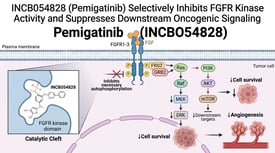
The Fibroblast Growth Factor Receptor (FGFR) family consists of four highly conserved transmembrane receptor tyrosine kinases (FGFR1-4) that bind to a diverse group of fibroblast growth factor (FGF) ligands. Upon ligand binding and stabilization by heparin sulfate proteoglycans, FGFRs undergo dimerization and transphosphorylation of their intracellular kinase domains. This recruits the adaptor protein FRS2, which serves as a hub for activating several key signaling cascades: the Ras/Raf/MEK/ERK pathway for proliferation, the PI3K/Akt pathway for survival, and the PLCγ pathway for calcium signaling and cell motility. FGFR signaling is vital for normal physiological processes such as embryogenesis, tissue repair, and phosphate homeostasis. However, aberrant FGFR signaling—driven by gene amplification, chromosomal translocations (fusions), or activating point mutations—is a major driver in a wide range of human cancers, including intrahepatic cholangiocarcinoma, urothelial carcinoma, breast cancer, and squamous cell lung cancer. FGFR inhibitors are generally classified into three main types.
Pan-FGFR inhibitors target FGFR1, 2, and 3 (and sometimes 4) with similar potency. These include the first wave of approved drugs like erdafitinib (for urothelial carcinoma) and pemigatinib and futibatinib (for cholangiocarcinoma). Erdafitinib and pemigatinib are reversible ATP-competitive inhibitors, whereas futibatinib is a next-generation irreversible (covalent) inhibitor that binds to a highly conserved cysteine residue in the ATP-binding pocket, potentially offering more durable inhibition and activity against certain gatekeeper mutations. The second category consists of selective FGFR inhibitors, such as those specifically targeting FGFR4 to treat hepatocellular carcinoma while avoiding the hyperphosphatemia associated with FGFR1-3 inhibition. The third category includes biological agents like monoclonal antibodies and FGF traps that neutralize ligands or prevent receptor dimerization. A significant challenge in FGFR-targeted therapy is the management of on-target toxicities.
Because FGFR1 is involved in renal phosphate handling, its inhibition leads to hyperphosphatemia, which requires careful monitoring and the use of phosphate-lowering agents. Other common side effects include ocular toxicities (central serous retinopathy) and nail/skin changes. Resistance is another major hurdle, often arising through secondary mutations in the kinase domain (e.g., the N546K or V561M gatekeeper mutations) or the activation of bypass pathways like MET or ErbB signaling. Current research is focused on developing mutation-biased inhibitors that can overcome these secondary mutations and exploring combination therapies with chemotherapy or immunotherapy. For example, FGFR inhibition has been shown to modulate the tumor microenvironment, potentially enhancing the efficacy of PD-1/PD-L1 blockers. Beyond oncology, FGFR modulators are being investigated for genetic disorders like achondroplasia, where the drug vosoritide (a C-type natriuretic peptide analog) acts to antagonize overactive FGFR3 signaling in growth plates.
This broadens the clinical impact of FGFR modulation beyond the realm of cancer treatment.