Fexagratinib (AZD4547) Synergizes with PI3K Inhibition to Overcome FGFR1-N546K Resistance in Neuroblastoma
Copy code to add this image to your page
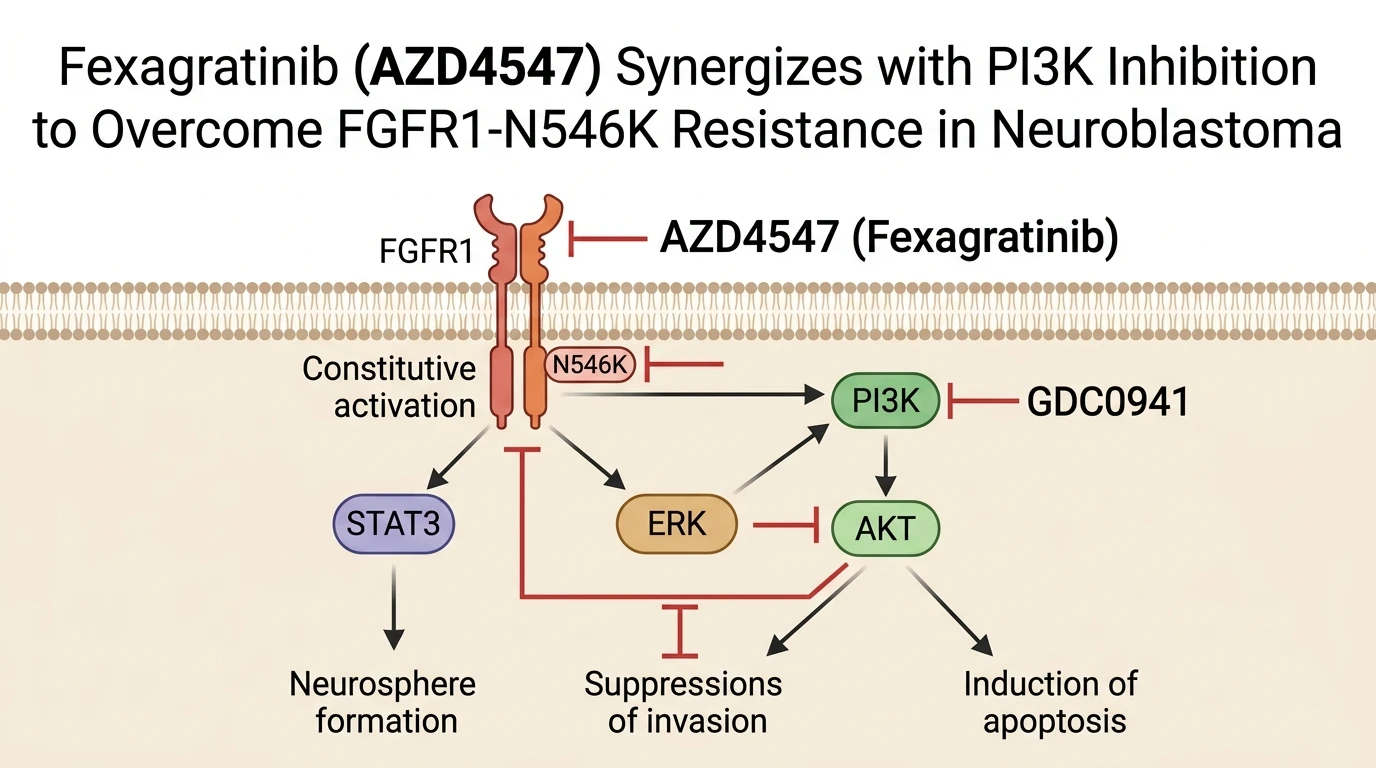
Neuroblastoma remains one of the most clinically challenging pediatric solid tumors, characterized by marked genetic heterogeneity and distinct neurodevelopmental origins. Genomic profiling identifies Fibroblast Growth Factor Receptor 1 (FGFR1) as a functional driver oncogene in a subset of aggressive neuroblastoma cases. High baseline cellular expression of FGFR1 strongly correlates with reduced event-free and overall patient survival across multiple clinical cohorts. The oncogenic potential of FGFR1 is further amplified by recurrent somatic point mutations within the intracellular kinase domain, notably the N546K substitution located in the kinase activation loop.\n\nBiochemically, the FGFR1 N546K mutation disrupts the auto-inhibitory conformation of the kinase domain. This molecular alteration leads to constitutive ligand-independent receptor autophosphorylation and altered subcellular trafficking, including increased nuclear localization. Cells expressing FGFR1 N546K exhibit enhanced clonogenicity, migratory capacity, and baseline invasive phenotype compared to wild-type controls. While wild-type FGFR1 signaling remains sensitive to nanomolar concentrations of the ATP-competitive tyrosine kinase inhibitor AZD4547 (Fexagratinib), cells bearing the N546K mutation demonstrate profound primary resistance to Fexagratinib monotherapy in standard cellular viability and colony formation assays.\n\nPharmacological evaluation reveals that AZD4547 monotherapy fails to achieve sustained suppression of downstream signaling in N546K mutant cell lines. Although initial receptor target engagement occurs, the N546K mutant receptor engages compensatory bypass signaling mechanisms. Specifically, persistent activation of Signal Transducer and Activator of Transcription 3 (STAT3), Mitogen-Activated Protein Kinase (MAPK/ERK), and Phosphoinositide 3-Kinase (PI3K/AKT) pathways maintains survival and invasive signaling despite upstream receptor inhibition. This multi-node signaling redundancy renders single-agent TKI intervention insufficient for oncogenic control in mutant neuroblastoma models.\n\nTo overcome this intrinsic resistance, dual targeting strategies combining FGFR inhibition with downstream nodal blockades were systematically evaluated. The combination of AZD4547 with the selective Class I PI3K inhibitor GDC0941 effectively neutralizes this adaptive crosstalk. At physiologically achievable concentrations in patient-derived and engineered neuroblastoma models, simultaneous co-inhibition of FGFR1 and PI3K completely suppresses persistent AKT and STAT3 phosphorylation. Consequently, this rational combination therapy restores apoptotic sensitivity, blunts cellular invasion through extracellular matrix matrices, and profoundly reduces three-dimensional neurosphere self-renewal and formation efficiency in vitro.
Pharmacological Characterization and Resistance Reversal Dynamics
Copy code to add this image to your page
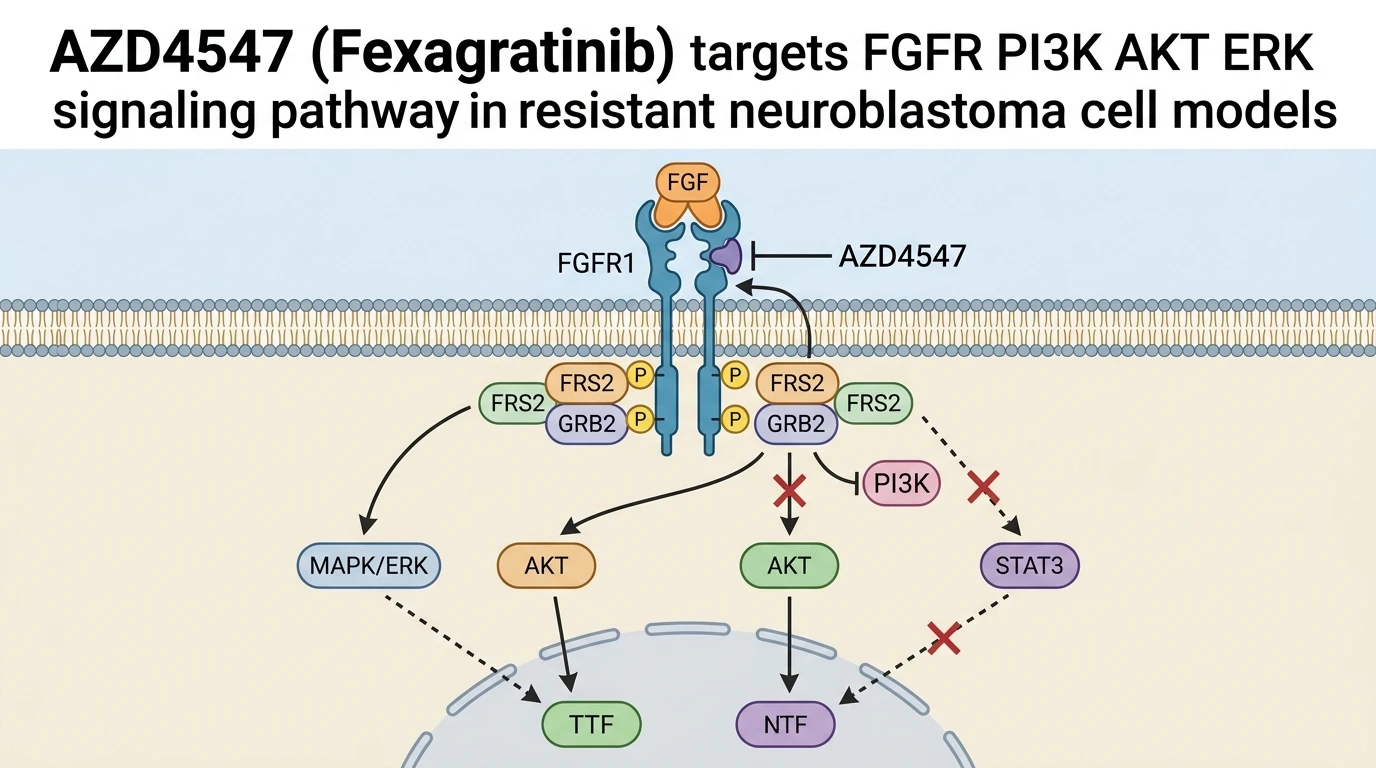
AZD4547 (Fexagratinib) functions as a selective small-molecule ATP-competitive tyrosine kinase inhibitor of FGFR1. While effective against wild-type receptor autophosphorylation, constitutive activation via the FGFR1 N546K mutation triggers resistance through bypass activation of STAT3, ERK, and AKT pathways. Co-administration of AZD4547 with the PI3K inhibitor GDC0941 neutralizes this compensatory crosstalk, effectively blocking downstream phosphorylation events, arresting cell invasion, and suppressing neurosphere formation in mutant neuroblastoma models.
Constitutive Activation of FGFR1 N546K Drives Resistance
The FGFR1 N546K substitution alters kinase activation loop dynamics. Receptor autophosphorylation remains persistently elevated under serum-starved assay conditions. Cellular survival assays demonstrated that wild-type FGFR1 expressing cells responded to Fexagratinib with low nanomolar IC50 values. In contrast, N546K mutant lines exhibited a marked upward shift in IC50 metrics. Biochemical profiling confirmed persistent STAT3 and ERK phosphorylation despite high concentrations of Fexagratinib. Downstream target suppression was transient. Receptor signaling rapidly adapted through alternative intracellular nodes.
PI3K Co-Inhibition Suppresses Compensatory STAT3 and AKT Crosstalk
Bypass signaling limits single-agent TKI efficacy in mutant models. Combining AZD4547 with the PI3K inhibitor GDC0941 targets these adaptive nodes directly. Western blot analyses demonstrated complete loss of phospho-AKT at S473 following dual treatment. Downstream STAT3 activation ceased entirely within six hours of exposure. This dual target engagement completely suppressed neurosphere growth in primary cell isolates. Control groups maintained active proliferation. The observed synergy remained localized to FGFR1 N546K mutated cellular contexts.
Attentuation of Invasiveness and Neurosphere Renewal In Vitro
Targeting single signaling nodes frequently fails in mutated tyrosine kinase models. Dual inhibition suppressed cell motility through Matrigel matrix chambers by over eighty percent. Sphere formation assays showed total loss of self-renewal capacity in secondary passages. Pharmacodynamic markers aligned with phenotype loss. Cellular apoptosis increased significantly under combination treatment protocols. Monotherapy regimens failed to produce equivalent apoptotic induction. These observations provide a mechanistic rationale for combined FGFR1 and PI3K blockade in resistant neuroblastoma subsets.