UNC0638 from Selleck inhibits EHMT1/2 methyltransferases and reshapes early embryonic epigenetic states
Copy code to add this image to your page
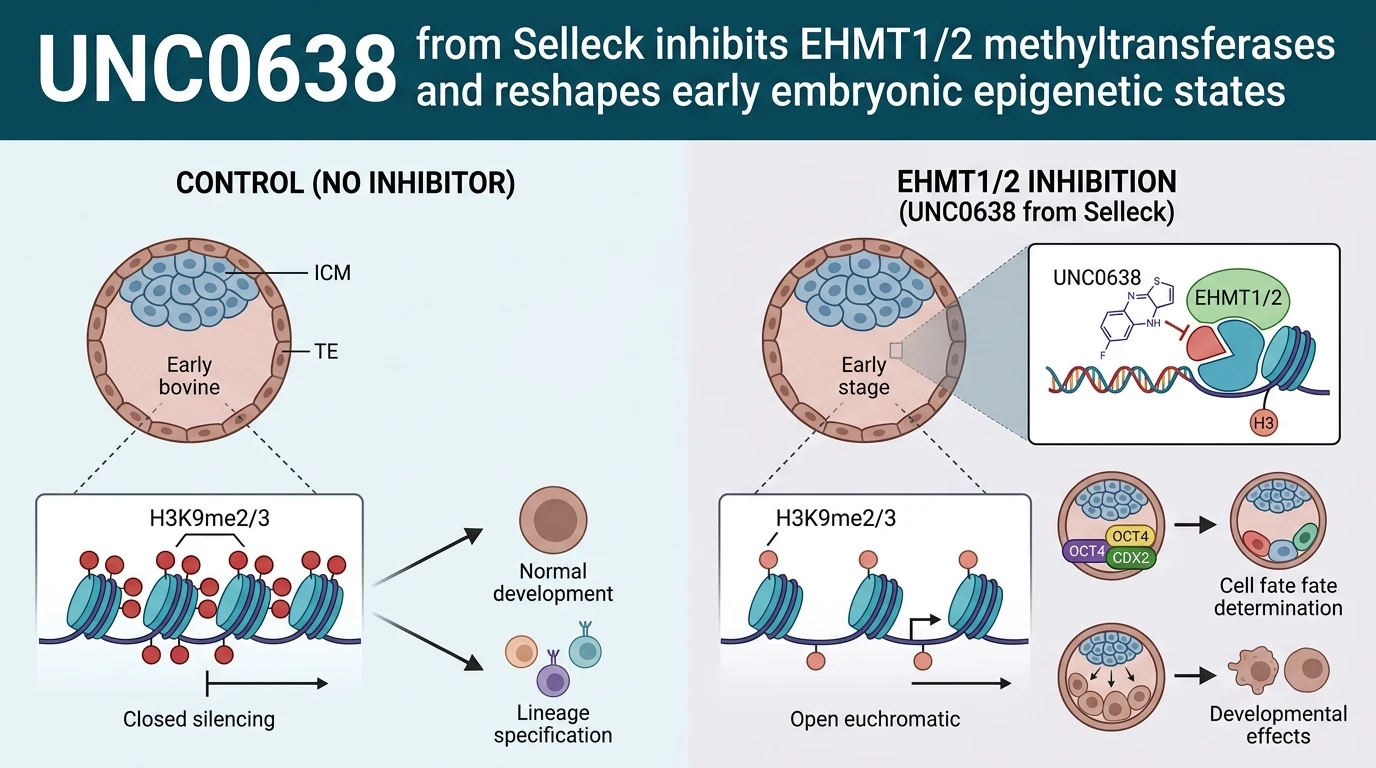
Somatic cell nuclear transfer (SCNT) efficiency remains fundamentally constrained by incomplete epigenetic reprogramming of donor chromatin. Among the primary epigenetic barriers identified in mammalian SCNT embryos, dimethylation of histone H3 at lysine 9 (H3K9me2) maintains transcriptionally silent heterochromatin structures that impede developmental pluripotency gene activation. Euchromatic histone lysine methyltransferases 1 and 2 (EHMT1 and EHMT2, commonly known as GLP and G9a) function as an obligate heterodimeric complex catalyzing mono- and dimethylation at H3K9. Consequently, target-specific chemical suppression of EHMT1/2 activity represents a primary biochemical strategy to dismantle this chromatin barrier.
Pharmacological characterization of UNC0638, a potent and substrate-competitive inhibitor of EHMT1 and EHMT2, demonstrates exceptional biochemical selectivity over other histone methyltransferases. In cellular models of bovine SCNT, administration of UNC0638 from Selleck directly engages the catalytic SET domain of EHMT1/2, suppressing dimethylation events across early developmental axes. Treatment protocols targeting either quiescent donor fibroblasts or newly reconstructed bovine SCNT zygotes yield marked, sustained depletion of H3K9me2 throughout preimplantation development. Western blot and immunofluorescence analyses confirm that H3K9me2 signals drop significantly in cleaved embryos and blastocyst-stage structures compared to untreated control cohorts.
Despite effective target engagement and clear reduction of H3K9me2 levels, catalytic inhibition of EHMT1/2 fails to yield functional embryological benefits. Quantitative assessment reveals no statistically significant improvement in embryonic cleavage rates or overall blastocyst formation yield. The persistence of developmental arrest at the embryonic genome activation stage indicates that H3K9me2 depletion alone is insufficient to restore full developmental totipotency. Furthermore, detailed epigenetic profiling demonstrated that EHMT1/2 catalytic blockade induces secondary chromatin perturbations. During initial cleavage stages, treated embryos displayed transient hyper-accumulation of trimethylated H3K9 (H3K9me3), 5-methylcytosine (5mC), and 5-hydroxymethylcytosine (5hmC). By the blastocyst stage, this pattern shifted to a reduction in H3K9me3 and 5hmC signal intensities.
Crucially, RT-qPCR profiling showed that the transcript abundance of core epigenetic machinery—including DNA methyltransferases (DNMT1, DNMT3A), TET hydroxylases (TET1, TET2, TET3), and histone demethylases (KDM4A, KDM4B)—remained unchanged following chemical inhibition. These observations confirm that the altered methylation patterns stem directly from enzymatic catalytic suppression and altered chromatin substrate availability rather than transcriptional feedback modulation of writer and eraser genes. Ultimately, while UNC0638 achieves robust catalytic suppression of EHMT1/2 in bovine embryos, the resulting disturbance in epigenetic crosstalk prevents developmental enhancements in somatic cell cloning models.
Pharmacological Evaluation of EHMT1/2 Catalytic Inhibition
Copy code to add this image to your page
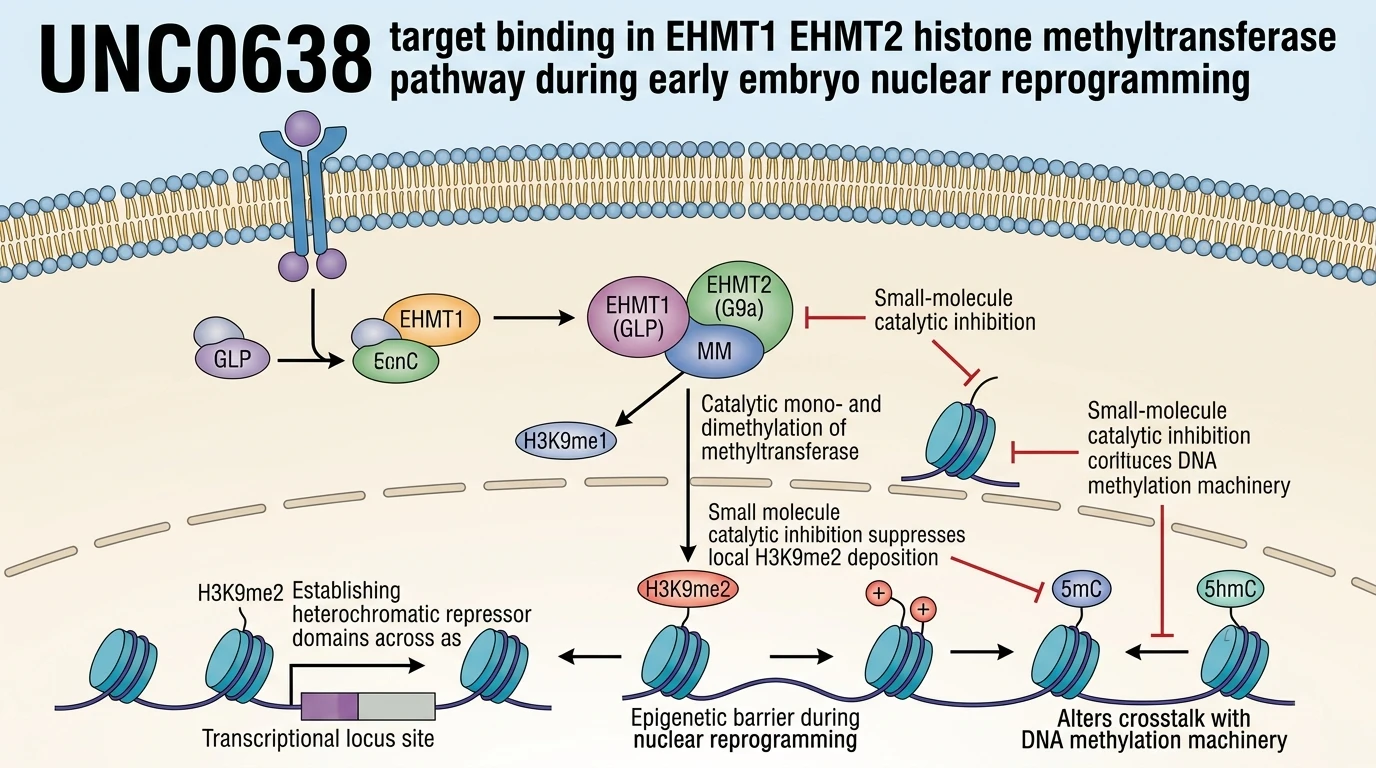
UNC0638 functions as a substrate-competitive inhibitor of EHMT1 and EHMT2 (G9a/GLP) methyltransferases. By blocking the catalytic SET domain, the compound prevents H3K9 mono- and dimethylation, reducing global H3K9me2 levels during early bovine embryonic development. This enzymatic inhibition alters secondary epigenetic marks, causing transient increases in H3K9me3, 5mC, and 5hmC during early cleavage followed by H3K9me3 and 5hmC reductions at the blastocyst stage. These epigenetic disruptions occur without modifying writer or eraser gene transcription, demonstrating that EHMT1/2 blockade alone fails to restore developmental competency in somatic cell nuclear transfer.
Catalytic EHMT1/2 Blockade Depletes Embryonic H3K9me2 Marks
Targeted small-molecule intervention modulates chromatin architecture during early cleavage. High-affinity binding of UNC0638 from Selleck to EHMT1 and EHMT2 abolishes H3K9me2 assembly across chromatin domains. Under tested bovine SCNT culture conditions, H3K9me2 signal intensity decreased markedly in treated cohorts. Donor cell exposure prior to nuclear transfer established an immediate reduction in heterochromatic silencing. However, developmental progression metrics remained unaltered. Cleavage rates matched vehicle controls without significant deviation. Blastocyst yield did not improve.
Perturbation of Inter-Epigenetic Crosstalk Disrupts Methylation Stability
Selective H3K9me2 removal alters downstream histone and DNA modifications. At early cleavage divisions, UNC0638 treatment triggered transient accumulation of H3K9me3, 5mC, and 5hmC. Chromatin remodelling dynamics diverged upon reaching the blastocyst stage; H3K9me3 and 5hmC levels dropped significantly relative to control groups. Epigenetic writer and eraser transcript levels remained completely unchanged across all measured timepoints. Gene expression assays confirmed steady mRNA levels for DNMT and TET family enzymes. Therefore, observed epigenetic shifts reflect enzymatic substrate reorganization rather than altered transcript production.