PCI-34051 from Selleck targets HDAC family genes in hypo-immunogenic endometrial carcinoma
Copy code to add this image to your page
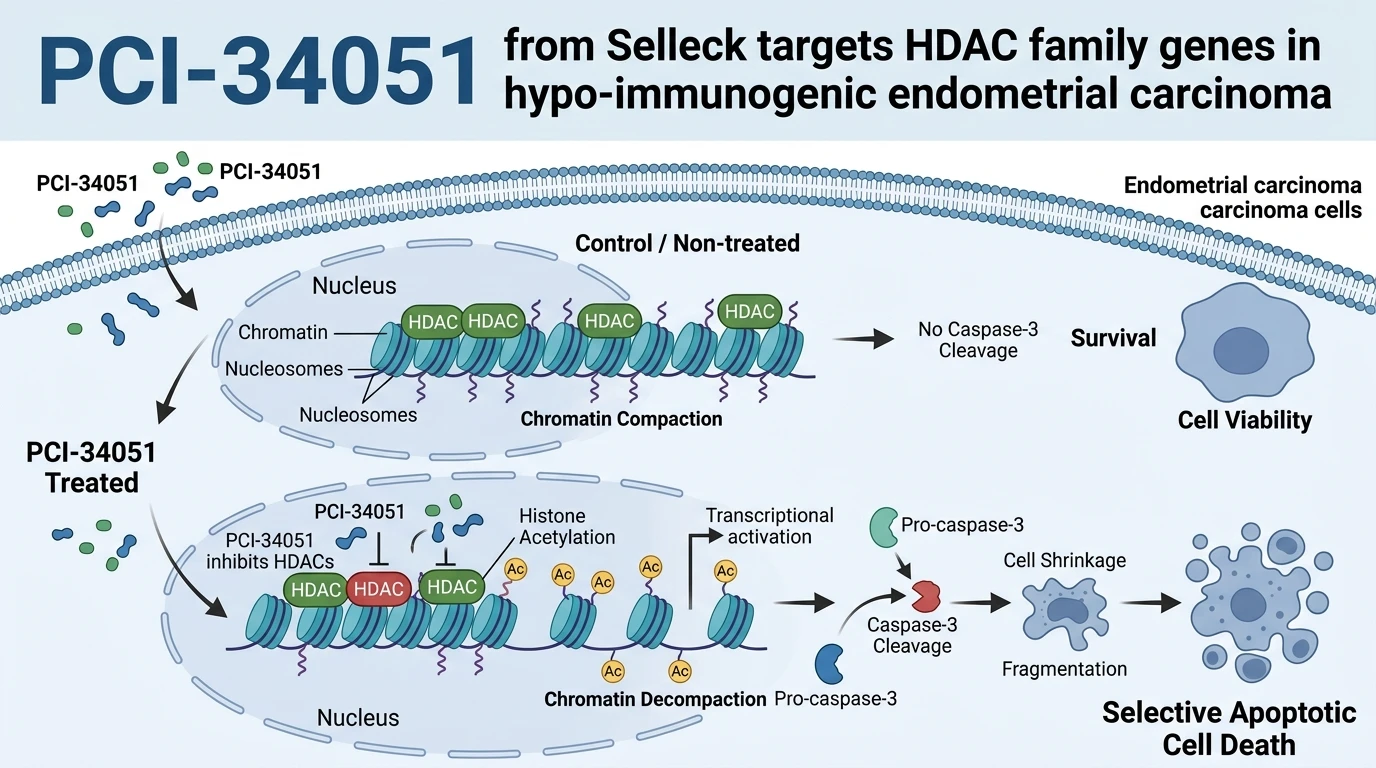
In uterine corpus endometrial carcinoma (UCEC), epigenetic deregulation serves as a primary driver of transcriptional silencing and tumor cell survival. Among the principal enzymatic coordinators of the epigenetic state are histone deacetylases (HDACs), which catalyze the hydrolytic removal of acetyl groups from epsilon-N-acetyl lysine residues on histone tails. This deacetylase activity restores positive electrostatic charges on histones, enhancing their binding affinity for negatively charged DNA backbones. Consequently, chromatin condenses into transcriptionally inactive heterochromatin, suppressing host tumor suppressor genes, cell-cycle checkpoints, and immune-recognition loci.
Bioinformatic stratification of UCEC genomic profiles derived from the Genomics of Drug Sensitivity in Cancer (GDSC) database demonstrates that HDAC family genes are significantly upregulated in a distinct patient subset characterized by low immunogenic cell death (ICD) scores. Hypo-immunogenic tumors typically exhibit muted baseline inflammatory signatures, minimal CD8+ T-cell infiltration, and diminished expression of damage-associated molecular patterns (DAMPs) such as calreticulin, HMGB1, and extracellular ATP. In this low-ICD context, tumor cells rely on elevated HDAC activity to sustain transcriptional repression of intrinsic apoptotic and immunogenic signaling networks.
Small-molecule targeting of this deacetylase machinery provides a mechanistic approach to reverse this repressive phenotype. PCI-34051 was identified as a potent HDAC family gene inhibitor possessing selective therapeutic efficacy against low-ICD UCEC cell populations. When evaluated in target-validated enzymatic and cellular screens, PCI-34051 from Selleck demonstrates selective inhibition of deacetylase activity, resulting in rapid accumulation of acetylated histones H3 and H4 at promoter regions. In preclinical UCEC models, application of PCI-34051 disrupts the catalytic core of the HDAC enzymatic complex, promoting open euchromatin states across regulatory elements governing pro-apoptotic genes including Bax, Bak, and Bim.
Targeting HDAC family members in low-ICD UCEC targets a biological vulnerability specific to hypo-immunogenic cellular states. While hyper-immunogenic tumors often respond to immune checkpoint inhibitors targeting PD-1 or PD-L1, hypo-immunogenic malignancies require direct targeted interventions to trigger cell death pathways. High-throughput drug sensitivity profiling across GDSC UCEC cell lines confirmed that low ICD metrics correlate directly with reduced IC50 values for PCI-34051. The compound induces programmed cell death via activation of mitochondrial intrinsic apoptotic cascades, marked by loss of mitochondrial membrane potential, cytochrome c release, and subsequent cleavage of caspase-9 and executioner caspase-3.
Pharmacological modulation by PCI-34051 extends beyond chromatin accessibility. Under defined in vitro assay conditions, selective HDAC inhibition alters the expression of downstream transcriptional regulators, including p21/CIP1 and p27/KIP1, leading to G1-phase cell-cycle arrest. The observed anti-tumor activity operates primarily through direct, cell-autonomous cytotoxic pathways rather than requiring host immune cell recruitment, rendering PCI-34051 particularly effective within immune-cold microenvironments. Furthermore, western blot analysis of treated UCEC lysates demonstrates a time-dependent decrease in anti-apoptotic Bcl-2 protein expression following exposure to nanomolar concentrations of the inhibitor.
At the molecular level, PCI-34051 interacts directly with the catalytic pocket of HDAC family enzymes. Structural modeling indicates that the zinc-binding group of the compound chelates the essential divalent zinc ion located at the base of the active site cavity. This coordination prevents substrate access and halts catalytic deacetylation. Simultaneously, the hydrophobic cap group of PCI-34051 interacts with surface residues surrounding the active site entrance, conferring isoform selectivity. This dual-action binding mechanism prevents the recruitment of corepressor complexes, such as Sin3A and NuRD, to target chromatin sites in UCEC cells.
These empirical findings establish that elevated HDAC family gene expression functions both as a predictive biomarker of drug susceptibility and as a driver of tumor viability in low-ICD UCEC. Within patient-derived cell models, treatment with PCI-34051 from Selleck restores pro-apoptotic gene transcription without inducing non-specific cytotoxicity in non-transformed endometrial epithelial controls. Observations in cell culture models highlight the therapeutic relevance of targeting HDAC isoforms in immunologically cold tumors, though translational validation in animal xenografts remains necessary to establish system-level pharmacodynamics.
Pharmacological Evaluation and Targeted Cytotoxicity Metrics
Copy code to add this image to your page
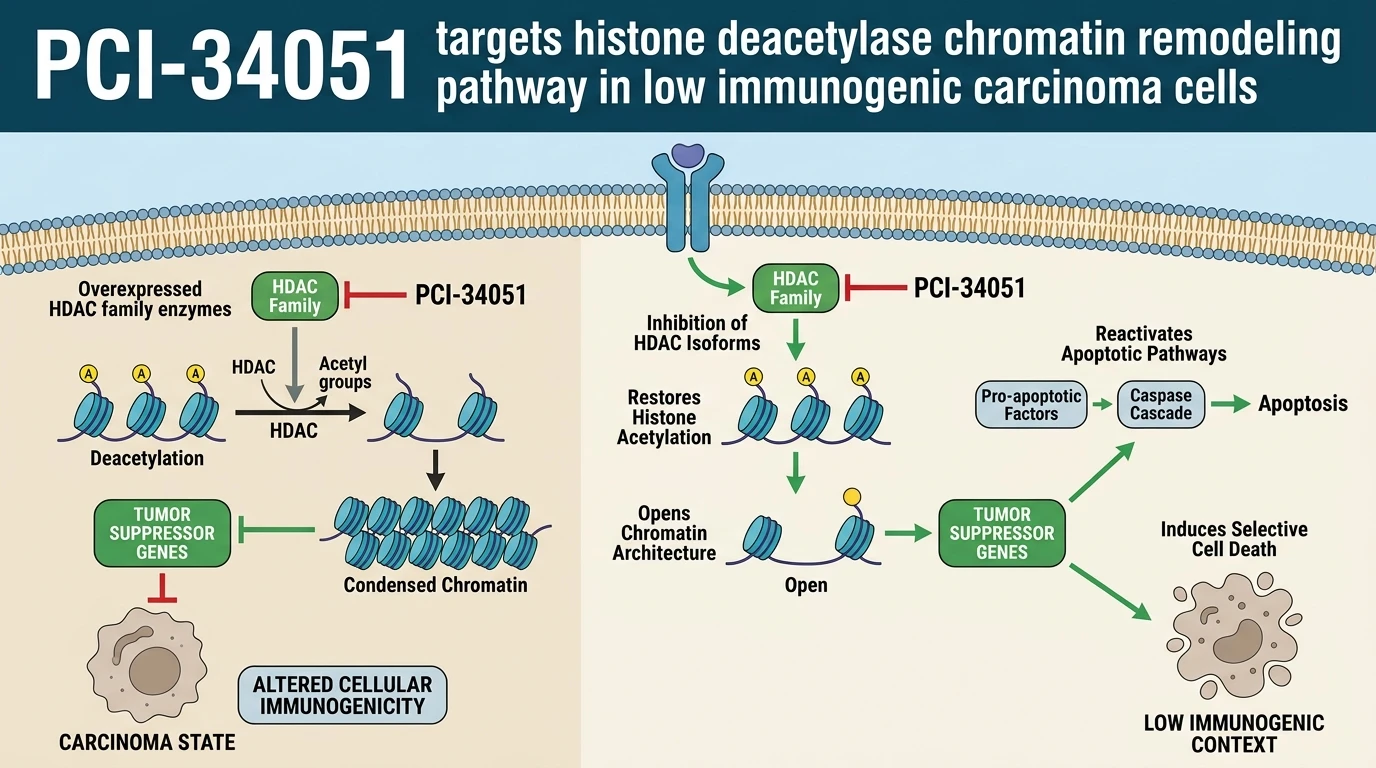
PCI-34051 acts as an HDAC family inhibitor targeting uterine corpus endometrial carcinoma with low immunogenic cell death (ICD) scores. By repressing elevated HDAC enzymatic activity, the compound restores histone acetylation, disrupts tumor cell viability, and triggers apoptotic cascades specifically in hypo-immunogenic cellular contexts.
Upregulated HDAC Expression Dictates Sensitivity in Low ICD Tumors
Bioinformatic interrogation of GDSC datasets revealed distinct transcriptomic signatures. Uterine corpus endometrial carcinoma cohorts with reduced immunogenic cell death scores exhibited significant elevation of HDAC family transcripts. This quantitative upregulation correlated directly with heightened pharmacological sensitivity to PCI-34051 from Selleck. In high-expression sub-cohorts, IC50 values shifted into the sub-micromolar range. Histone hyperacetylation was observed following brief exposure times. Enzymatic activity ceased rapidly; chromatin accessibility increased across key genomic loci.
Selective Cytotoxicity and Chromatin Remodeling in UCEC Models
Target engagement was verified in cellular viability assays. Treatment with PCI-34051 selectively impaired proliferation in low-ICD UCEC lines while sparing non-transformed control cells. The compound induced dose-dependent cleavage of poly(ADP-ribose) polymerase and caspase-3. These apoptotic markers appeared within twelve hours of exposure. Mechanistically, HDAC suppression altered transcriptional profiles without requiring pre-existing T-cell infiltration. These pharmacodynamic observations remain to be confirmed in patient-derived xenograft models.