GSK343 target engagement in EZH2-driven breast cancer models
Copy code to add this image to your page
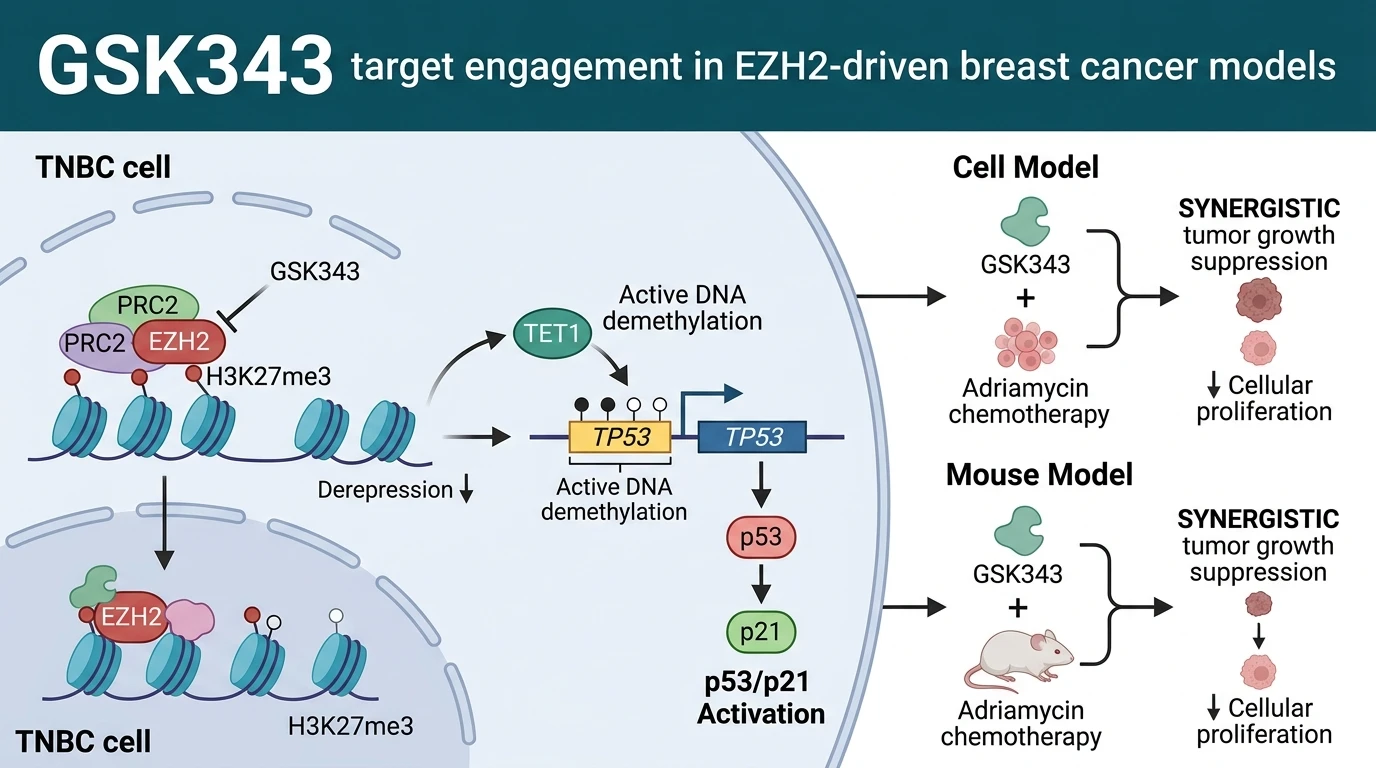
Triple-negative breast cancer (TNBC) remains a clinically challenging malignancy due to the absence of estrogen receptor, progesterone receptor, and human epidermal growth factor receptor 2 expression. Epigenetic alterations heavily influence the aggressive phenotype of TNBC. Enhancer of Zeste Homolog 2 (EZH2), the primary catalytic subunit of Polycomb Repressive Complex 2 (PRC2), functions as a histone methyltransferase that catalyzes the trimethylation of histone H3 at lysine 27 (H3K27me3). Elevated levels of EZH2 and H3K27me3 induce transcriptional repression of tumor suppressor genes across diverse cellular contexts. In TNBC cell populations, aberrantly high EZH2 catalytic activity directly represses the expression of Ten-Eleven Translocation 1 (TET1), a methylcytosine dioxygenase responsible for converting 5-methylcytosine to 5-hydroxymethylcytosine. Downregulation of TET1 impairs active DNA demethylation, reinforcing promoter hypermethylation and silencing critical downstream effectors, notably TP53.
To reverse this repressive state, researchers utilize GSK343, a potent and selective S-adenosyl-L-methionine-competitive inhibitor of EZH2 methyltransferase activity. Administration of GSK343 directly targets the catalytic SET domain of EZH2, effectively blocking the transfer of methyl groups to H3K27 residues. At nanomolar to low micromolar concentrations, GSK343 demonstrates high selectivity for EZH2 over related histone methyltransferases, including EZH1 and SET-domain containing enzymes. In experimental TNBC models, treatment with GSK343 induces a rapid, concentration-dependent depletion of global H3K27me3 abundance without perturbing total EZH2 protein stability. Depletion of H3K27me3 marks at the promoter region of TET1 derepresses its transcription, resulting in a substantial, reproducible increase in TET1 mRNA and protein accumulation. Re-expressed TET1 localizes to nuclear chromatin, where its dioxygenase activity targetedly catalyzes the oxidation of methylated cytosine bases.
The elevation of functional TET1 directly alters the epigenetic topology of the TP53 promoter. Quantitative PCR and bisulfite sequencing analyses confirm significant CpG demethylation across the TP53 promoter, establishing a direct mechanistic link between EZH2 enzymatic block and promoter reactivations. TET1 physical engagement at CpG sites within the TP53 regulatory region facilitates active DNA demethylation, relieving transcriptional silencing. Consequently, cellular transcription of TP53 resumes, leading to a robust elevation of functional p53 protein levels. Up-regulated p53 subsequently functions as a transcription factor, driving the expression of cyclin-dependent kinase inhibitor 1A (p21/CIP1/WAF1). Enhanced p21 expression prevents cyclin-CDK complex activity, triggering G1 phase cell cycle arrest. Over prolonged incubation periods, sustained activation of the p53-p21 signaling axis transitions growth-arrested cells into a phenotype characterized by cellular senescence and programmed cell death.
Beyond single-agent activity, combining EZH2 inhibition with conventional DNA-damaging cytotoxic drugs enhances therapeutic response. Co-administration of GSK343 with the anthracycline chemotherapeutic agent Adriamycin produces synergistic antiproliferative activity in TNBC lines. The synergism between GSK343 and Adriamycin exhibits combination index values well below 1.0, indicative of authentic pharmacological synergy rather than additive toxicity. The combination significantly amplifies intracellular reactive oxygen species, accentuates p53 pathway engagement, and drives a higher percentage of cells into senescence and annexin V-positive apoptotic states compared to monotherapy. In mouse xenograft models harboring human TNBC tumors, systemically administered GSK343 significantly retards primary tumor volume growth. In vivo pharmacokinetic measurements indicate sustained target engagement without causing systemic toxicity or substantial body weight loss in host animals. Immunohistochemical evaluations of harvested xenograft tissues confirm depleted H3K27me3, up-regulated TET1 and p53 expression, and reduced Ki-67 proliferation indices. These empirical observations establish that targeting EZH2 catalytic activity restores the suppressed TET1-p53 tumor suppressor pathway in TNBC models.
Pharmacological Target Validation and Epigenetic Signaling Modulation
Copy code to add this image to your page
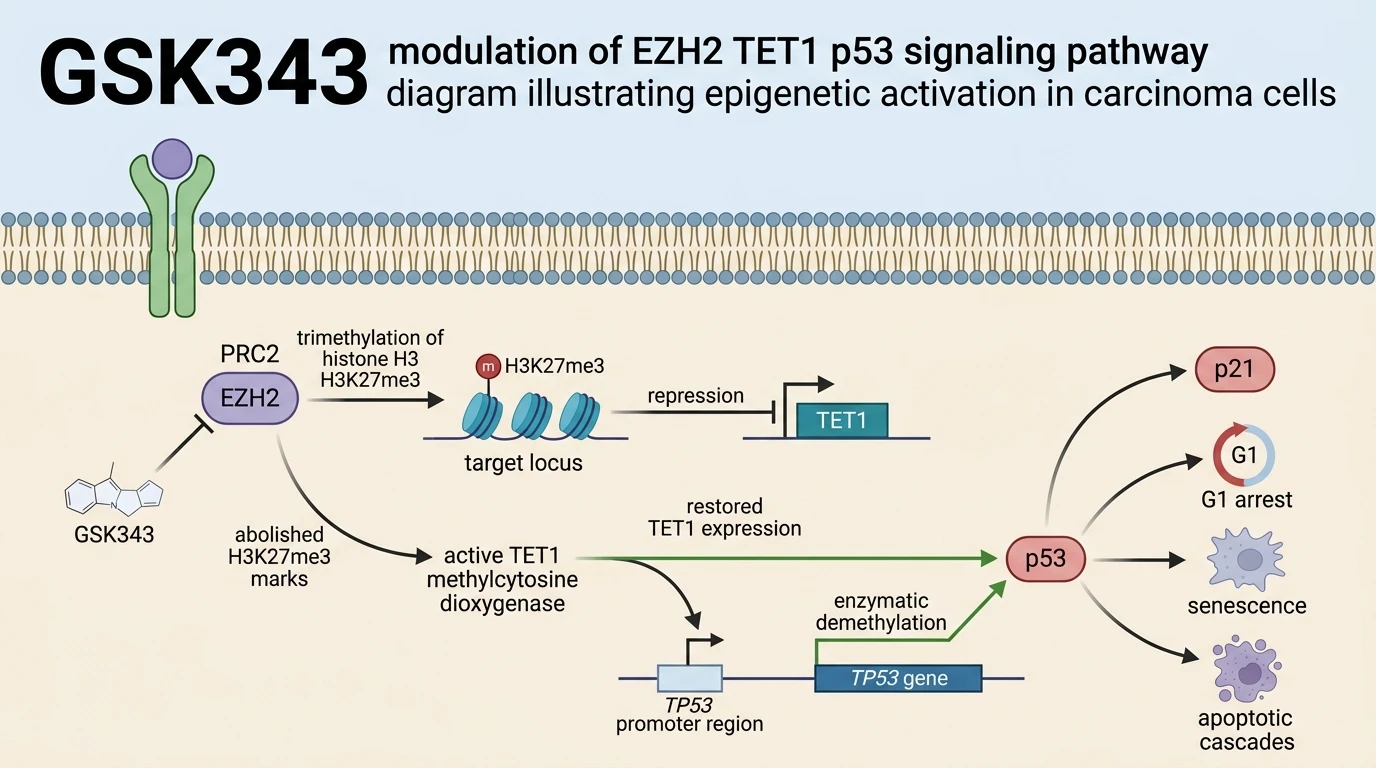
GSK343 is a selective small-molecule inhibitor targeting the EZH2 histone methyltransferase catalytic domain. By blocking H3K27me3 catalytic deposition, GSK343 derepresses TET1 transcription in triple-negative breast cancer cells. Re-expressed TET1 dioxygenase actively demethylates the TP53 promoter region, driving downstream p53 and p21 pathway activation. This signaling cascade triggers G1 phase cell cycle arrest, cellular senescence, and apoptosis. Furthermore, GSK343 acts synergistically with Adriamycin to suppress tumor growth in murine xenograft models, validating EZH2 catalytic inhibition as a targeted epigenetic therapeutic strategy.
TET1 Promoter Derepression Restores p53 Transcriptional Activation
In triple-negative breast cancer cell lines, inhibition of EZH2 by GSK343 systematically alters the local chromatin architecture at repressed tumor suppressor loci. H3K27me3 catalytic marks decrease within 24 hours. Histone demethylation directly relieves transcriptional repression at the TET1 promoter locus, permitting robust restoration of TET1 dioxygenase mRNA and protein expression. Elevated TET1 binds the TP53 promoter. Enzymatic conversion of 5-methylcytosine to 5-hydroxymethylcytosine reduces promoter methylation density, resulting in a marked reactivation of p53 transcription in patient-derived models. Downstream p21 expression accumulates rapidly in vitro. Sustained p21 elevation suppresses cyclin-dependent kinase activity, which precipitates robust G1 phase cell cycle arrest and activates senescence programs.
Synergistic Combination with Chemotherapy Suppresses Murine Tumor Growth
Combining small-molecule EZH2 inhibition with conventional DNA-damaging chemotherapeutics enhances cytotoxic efficacy in recalcitrant breast cancer models. Cellular proliferation declines rapidly. Co-treatment schedules pairing GSK343 with Adriamycin yield pronounced synergistic cell growth inhibition in patient-derived cell models. Apoptotic rates increase markedly. Mechanistically, dual intervention enhances intracellular reactive oxygen species accumulation while driving higher percentages of cells into annexin V-positive terminal apoptotic states. Tumor volumes decreased sharply in vivo. In murine xenograft models bearing human TNBC tumors, systemic drug administration retards primary tumor growth while preserving animal body weight metrics. Ki-67 markers confirmed target engagement.