VS-4718 (PND-1186) VS-4718 FAK inhibitor Suppresses IGF-1-Driven YAP Activation in TNBC
Copy code to add this image to your page
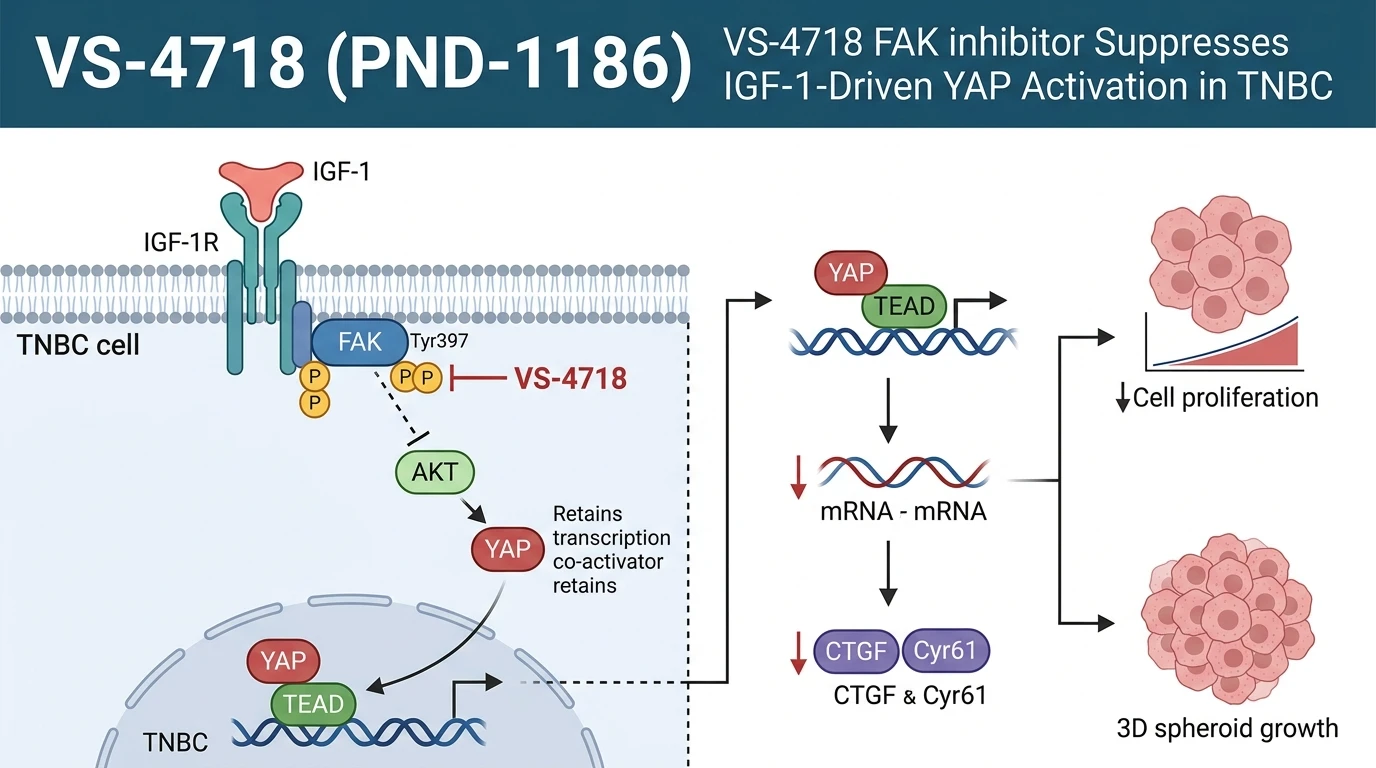
Triple-negative breast cancer (TNBC) represents an aggressive clinical subtype defined by the functional absence of estrogen receptor, progesterone receptor, and HER2 expression. Clinical transcriptomic profiling indicates that elevated expression of insulin-like growth factor-1 (IGF-1) or its cognate receptor tyrosine kinase, IGF-1R, correlates directly with diminished disease-free survival in patients with TNBC. Gene set enrichment analyses demonstrate simultaneous enrichment of focal adhesion networks and Hippo pathway transcriptional effectors within IGF-1-high tumor cohorts. At the molecular level, extracellular binding of IGF-1 to IGF-1R stimulates physical receptor dimerization and autophosphorylation at catalytic domain tyrosine residues.
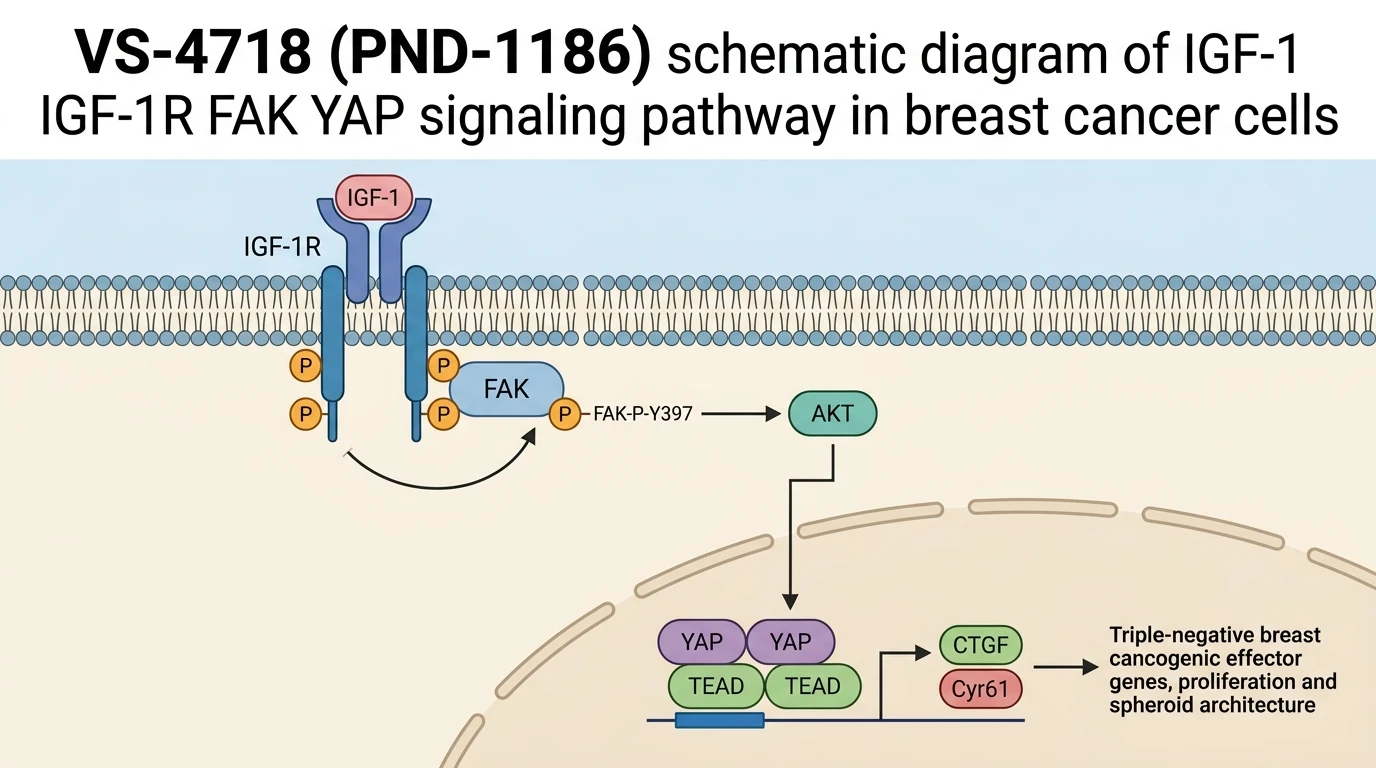
Upon ligand engagement, IGF-1R forms a direct physical complex with Focal Adhesion Kinase (FAK), a non-receptor tyrosine kinase localized to cell-matrix focal adhesions. This protein-protein engagement triggers trans-phosphorylation of FAK at its primary autophosphorylation site, Tyr397. Phosphorylated Tyr397 functions as a high-affinity docking site for the SH2 domain of Src family kinases, inducing secondary phosphorylation events that maximize FAK catalytic activity. Signal propagation downstream of the assembled IGF-1R/FAK complex engages the serine/threonine kinase AKT. Activation of AKT downstream of FAK promotes the nuclear translocation of Yes-associated protein (YAP), a primary transcriptional co-activator belonging to the Hippo pathway.
In its unphosphorylated nuclear state, YAP interacts with TEA domain (TEAD) family transcription factors. The resulting nuclear YAP/TEAD complexes directly bind promoter regions to execute the transcription of specific target genes, including connective tissue growth factor (CTGF) and cysteine-rich angiogenic inducer 61 (Cyr61). Elevated expression of CTGF and Cyr61 enhances cell proliferation, survival under matrix-detached conditions, and cellular migration. In cell models—such as those sourced from authenticated human breast cell repositories—this pathway maintains autonomous cell cycle progression.
Pharmacological disruption of this signaling architecture can be achieved with VS-4718 (PND-1186). As a selective, ATP-competitive inhibitor of FAK, VS-4718 binds the ATP-binding pocket of the kinase domain, blocking autophosphorylation at Tyr397 in a concentration-dependent manner. In cultured TNBC models stimulated with exogenous IGF-1 (100 ng/mL), pre-incubation with VS-4718 abrogates downstream AKT phosphorylation and suppresses YAP nuclear accumulation. Lacking nuclear co-activator activity, TEAD promoter occupancy is reduced, yielding substantial downregulation of CTGF and Cyr61 mRNA and protein expression.
In cellular assays, treatment with the VS-4718 FAK inhibitor causes dose-dependent inhibition of monolayer proliferation and clonogenic survival. Under 3D spheroid culture conditions that mimic native extracellular matrix architecture, VS-4718 administration disrupts spheroid integrity and restricts volumetric expansion. These observations indicate that targeting FAK kinase activity disrupts the biochemical link connecting upstream IGF-1R activation to nuclear YAP/TEAD transcriptional programs in TNBC.
Pharmacological Evaluation of FAK Inhibition in TNBC Models
Copy code to add this image to your page
VS-4718 (PND-1186) is a selective, ATP-competitive inhibitor of Focal Adhesion Kinase (FAK). Binding of IGF-1 to IGF-1R recruits FAK, prompting FAK autophosphorylation at Tyr397, downstream AKT activation, nuclear translocation of YAP, and TEAD-mediated expression of target genes CTGF and Cyr61. By inhibiting FAK kinase activity, VS-4718 blocks IGF-1-induced YAP nuclear accumulation and transcriptional output, suppressing proliferation, colony formation, and 3D spheroid growth in triple-negative breast cancer models.
IGF-1R Binding Drives FAK Tyr397 Autophosphorylation
Binding of ligand to IGF-1R induces immediate receptor phosphorylation. This membrane event recruits FAK to the receptor complex; direct physical engagement follows rapidly. FAK autophosphorylation at Tyr397 occurs within five minutes of ligand exposure under tested in vitro conditions. Phosphorylation of this regulatory node recruits Src, establishing an active dual-kinase complex. Application of the VS-4718 FAK inhibitor effectively blocks Tyr397 autophosphorylation across tested TNBC cell models. Downstream phosphorylation of AKT (Ser473) dropped sharply upon drug treatment. Kinase inhibition remained highly selective at sub-micromolar concentrations.
YAP Nuclear Import and Target Transcription Require FAK Activity
Unphosphorylated YAP translocates into the nucleus upon IGF-1 stimulation. Once nuclear, YAP binds TEAD domains—driving transcript production of CTGF and Cyr61. Cellular immunofluorescence revealed that VS-4718 treatment traps YAP within the cytoplasm. Consequently, TEAD promoter activity declined by over seventy percent within twelve hours. Transcript levels of CTGF decreased markedly—confirming functional blockade of Hippo transcriptional co-activation. The observed transcriptional suppression directly reduced matricellular protein accumulation in extracellular assays.
FAK Kinase Inhibition Disrupts 3D Spheroid Growth Dynamics
Monolayer cultures exhibit reduced clonogenic survival under continuous drug exposure. Three-dimensional spheroid models reproduce matrix-dense solid tumor architecture. Spheroid expansion halted following exposure to the VS-4718 FAK inhibitor at physiologically relevant concentrations (100–300 nM). Structural integrity degraded within seventy-two hours; apoptotic markers increased simultaneously. Control spheroids maintained uninterrupted volumetric growth throughout the six-day observation period. These data confirm that FAK suppression disrupts non-anchored tumor survival pathways.