1-Azakenpaullone inhibitor targeting Gsk3β restores pancreatic beta cell function in diabetic mice
Copy code to add this image to your page
Pancreatic beta-cell failure and progressive reduction in functional islet mass represent central hallmarks of type 2 diabetes pathology. Intracellular signaling networks downstream of receptor tyrosine kinases govern the delicate balance between beta-cell survival, proliferation, and metabolic execution. Among these receptors, the stem cell factor receptor c-Kit coordinates essential survival cascades in endocrine progenitor cells and mature functional islets. In murine models bearing a loss-of-function mutation in c-Kit, designated as c-KitWv/+, receptor signaling efficiency drops sharply. This catalytic attenuation leads directly to diminished downstream activation of phosphatidylinositol 3-kinase (PI3K) and a corresponding reduction in Akt phosphorylation at the key regulatory residue Ser473.
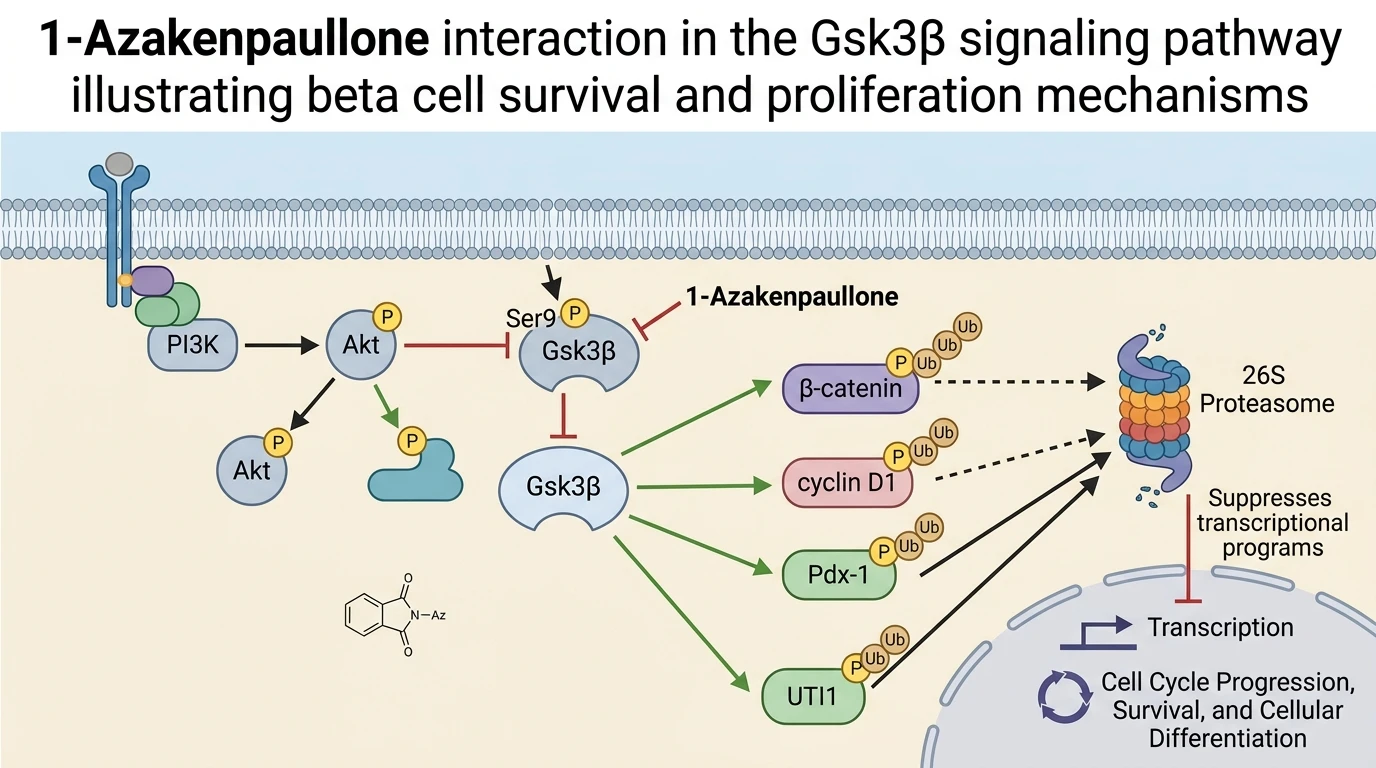
Under baseline physiological conditions, activated Akt phosphorylates glycogen synthase kinase 3β (Gsk3β) at Ser9, placing this constitutively active kinase into an inactive, autoinhibited state. In the c-KitWv/+ mutant background, reduced Akt phosphorylation leaves Gsk3β predominantly unphosphorylated and catalytically active. Hyperactive Gsk3β rapidly engages its downstream transcription factor targets, transferring phosphate moieties onto specific serine and threonine motifs within β-catenin, cyclin D1, and pancreatic and duodenal homeobox 1 (Pdx-1). Phosphorylated forms of these critical proteins are recognized by E3 ubiquitin ligase complexes, driving their swift target degradation through the 26S proteasome network.
The accelerated turnover of β-catenin, cyclin D1, and Pdx-1 triggers a catastrophic collapse in beta-cell transcriptional output. Pdx-1 serves as a master regulator of pancreatic development and mature beta-cell identity, controlling transcription of the insulin gene itself as well as key glucose sensors such as Glut2 and glucokinase. Concurrently, loss of cyclin D1 halts G1/S phase cell cycle transition, severely restricting the regenerative capacity of mature islets. Reduced abundance of MafA, another key transcriptional partner stabilized downstream of this axis, further compromises insulin gene promoter activation. In male c-KitWv/+ mice, this biochemical cascade causes a marked decline in total beta-cell mass, severe deficits in glucose-stimulated insulin secretion (GSIS), and the development of early-onset overt diabetes.
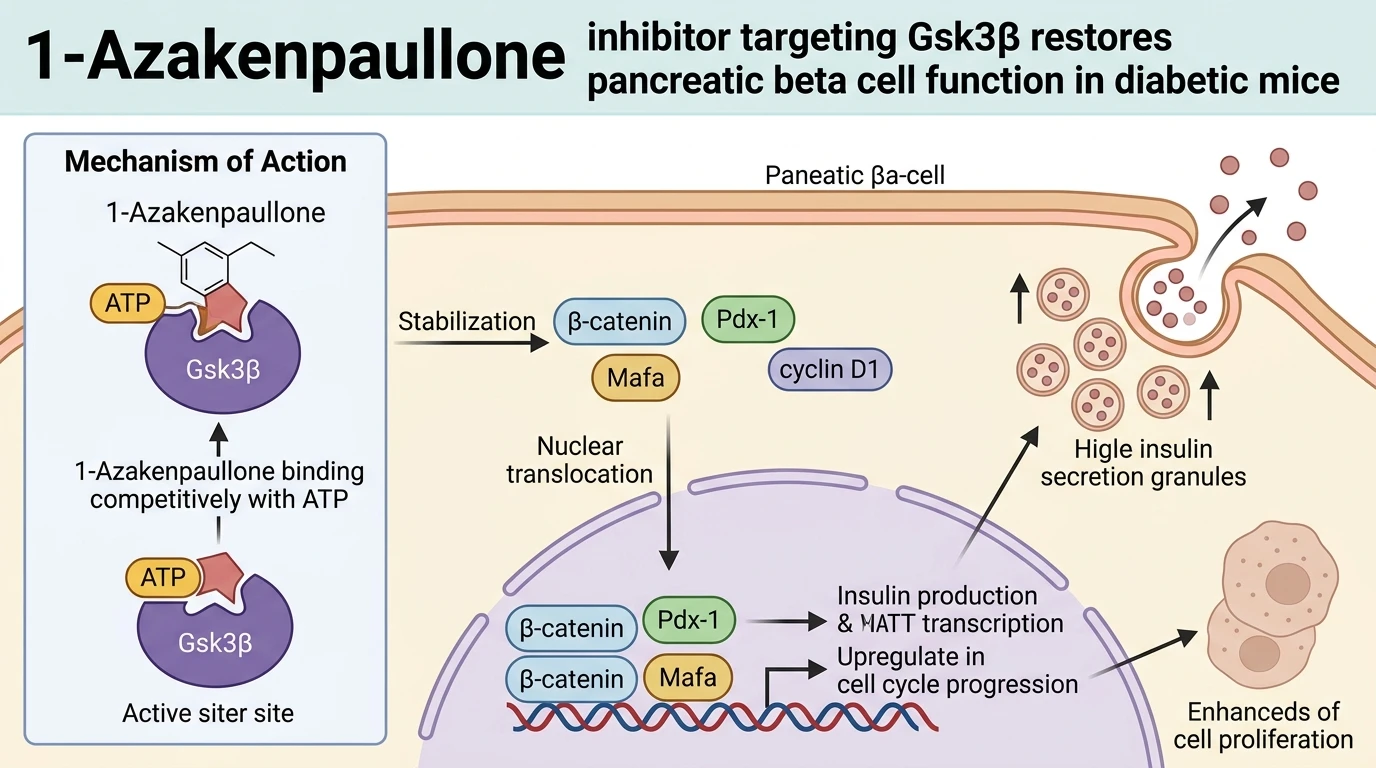
Pharmacological intervention using the selective 1-Azakenpaullone inhibitor offers an targeted mechanism to bypass upstream c-Kit receptor defects. As a small-molecule paullone derivative, 1-azakenpaullone (1-AKP) binds competitively to the ATP-binding pocket of Gsk3β, preventing ATP entry and abolishing substrate phosphorylation. Structural analyses derived from Gsk3β crystallographic binding site architecture highlight how paullone scaffold interactions occupy the hydrophobic ATP catalytic core with high target selectivity over related cyclin-dependent kinases. By directly suppressing Gsk3β enzymatic turnover, 1-AKP halts the hyper-phosphorylation cascade responsible for substrate clearance in mutant islets.
In treated c-KitWv/+ murine models, competitive blockade of Gsk3β catalytic activity rapidly stabilizes intracellular pools of β-catenin, cyclin D1, Pdx-1, and MafA. Non-phosphorylated β-catenin accumulates in the cytoplasm and translocates to the nucleus, engaging TCF/LEF transcription factors to drive cell cycle entry. Concurrent stabilization of Pdx-1 and MafA rescues insulin expression networks and restores normal granule maturation. At the tissue level, 1-AKP administration stimulates beta-cell proliferation, expands islet volume, restores normal glucose-stimulated insulin secretion profiles, and effectively prevents the onset of hyperglycemia in male mutant mice.
Gsk3β Kinase Inhibition and Islet Mass Preservation
Copy code to add this image to your page
1-Azakenpaullone acts as a selective, ATP-competitive inhibitor of glycogen synthase kinase 3β (Gsk3β). By binding to the Gsk3β catalytic domain, it suppresses phosphorylation of downstream targets, including β-catenin, cyclin D1, and Pdx-1. This inhibition prevents substrate proteasomal degradation, restoring transcription factor abundance essential for β-cell proliferation, survival, and insulin secretion.
Attenuation of Hyperactive Gsk3β Catalysis Preserves Substrate Abundance
Receptor tyrosine kinase signaling maintains metabolic homeostasis in pancreatic islets. In c-KitWv/+ mutant mice, diminished Ser473 phosphorylation on Akt relieves baseline inhibition on Gsk3β. Active Gsk3β rapidly phosphorylates downstream substrates. This enzymatic event targets β-catenin, cyclin D1, and Pdx-1 for immediate proteasomal degradation. Treating islet cultures with the 1-Azakenpaullone inhibitor selectively blocks ATP binding within the Gsk3β catalytic pocket. This competitive engagement prevents target phosphorylation. Substrate degradation rates drop significantly under these assay conditions. Consequently, protein levels of cyclin D1 and Pdx-1 stabilize in treated cells. This biochemical shift preserves key transcription factor networks required for islet integrity.
Restoration of Glucose-Stimulated Insulin Secretion and Glycemic Control
Islet dysfunction causes progressive hyperglycemia in male mutant animals. Systemic administration of 1-Azakenpaullone halts this degenerative trajectory in vivo. The compound restores nuclear localization of Pdx-1 and Mafa within primary beta cells. Elevated transcription factor abundance directly drives cell cycle re-entry. Beta cell proliferation increases notably across isolated pancreatic sections. Total functional beta cell mass expands within six weeks of treatment initiation. Insulin secretion assays confirm enhanced glucose responsiveness in treated cohorts. Plasma glucose levels clear efficiently following intraperitoneal challenge. Ultimately, small-molecule inhibition of Gsk3β prevents early-onset diabetes in this genetic model.
Targeted Kinase Suppression Mitigates Diabetic Phenotypes in Murine Models
Pathological kinase activation frequently undermines endocrine cell viability. In c-KitWv/+ mutant tissue, unrestrained Gsk3β activity impairs transcriptional networks governing insulin production. Targeted small-molecule therapy reverses this molecular deficit. Application of the selective 1-Azakenpaullone inhibitor suppresses Gsk3β catalytic activity at nanomolar concentrations. The blockade protects cytoplasmic β-catenin pools from degradation. Accumulated β-catenin translocates to the nucleus to trigger proliferative signaling cascades. Islet morphology remains intact during sustained pharmacological intervention. Blood glucose control aligns with non-mutant wild-type control groups.