PD0325901 (Mirdametinib) PD0325901 inhibitor target engagement in MEK1/2-mediated microglial neuroinflammation
Copy code to add this image to your page
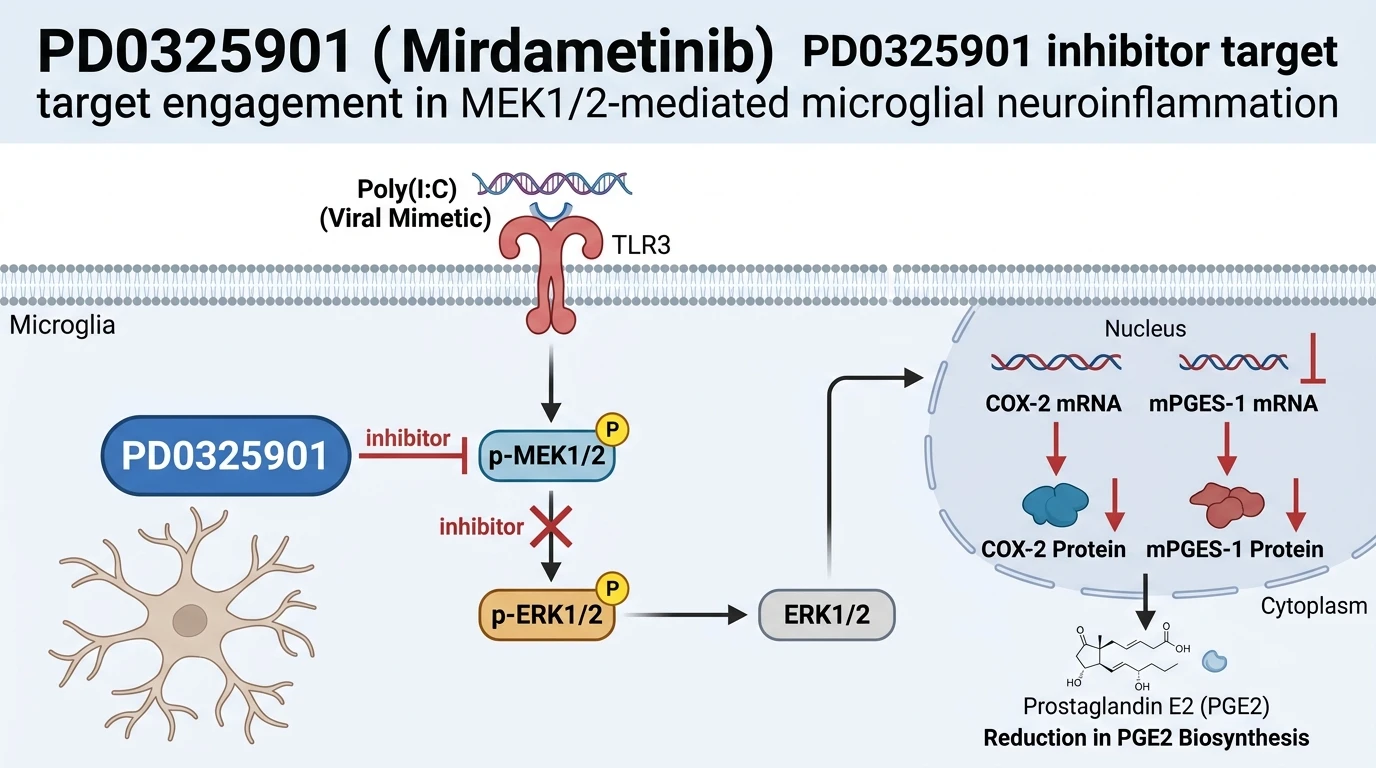
Double-stranded RNA (dsRNA) mimetics such as polyinosinic-polycytidylic acid [poly(I:C)] simulate viral exposure in central nervous system resident immune cells. In primary rat microglial cultures, poly(I:C) challenge triggers robust upregulation of microsomal prostaglandin E synthase-1 (mPGES-1) and cyclooxygenase-2 (COX-2), leading to elevated prostaglandin E2 (PGE2) release. The enzymatic cascade converts arachidonic acid to prostaglandin H2 via COX-2, followed by site-specific isomerization to PGE2 by mPGES-1. To clarify the downstream catalytic networks governing this inflammatory state, small-molecule kinase inhibitors serve as precise investigative tools.
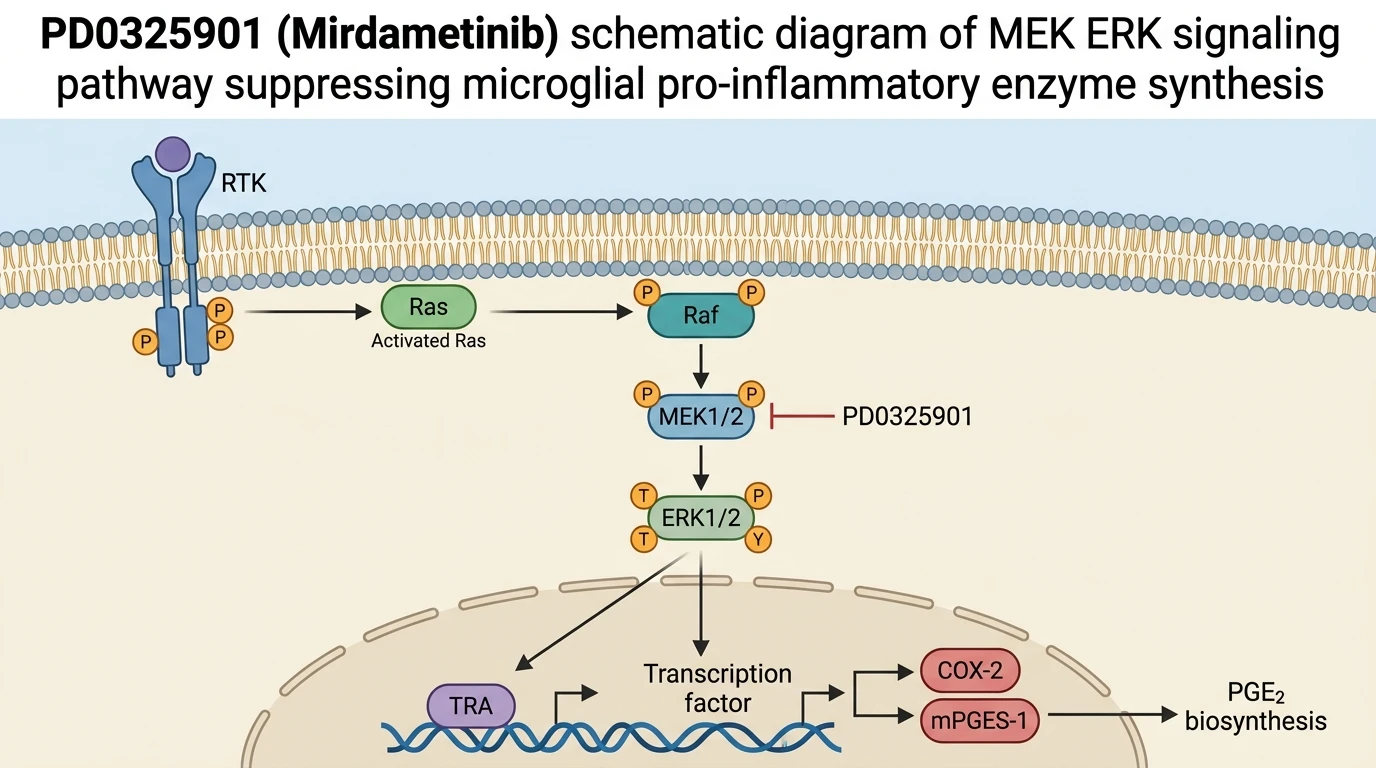
Targeting dual-specificity mitogen-activated protein kinase kinase 1/2, PD0325901 (Mirdametinib) functions as a potent allosteric inhibitor. Application of this selective PD0325901 inhibitor significantly suppressed poly(I:C)-induced protein accumulation of both COX-2 and mPGES-1 under primary culture assay conditions. The inhibition demonstrates that the MEK/ERK transduction axis is strictly required for viral-mimetic eicosanoid induction in microglia. Computational mapping of signaling downstream corroborates the direct linkage between MEK phosphorylation and nuclear transcription factor recruitment governing inflammatory gene promoter activity.
Poly(I:C) stimulation induces rapid target phosphorylation across multiple signaling nodes. Western blot assays confirm direct, time-dependent phosphorylation of ERK1/2, c-Jun N-terminal kinase (JNK), p38 MAPK, Akt, and IκB-α within minutes of exposure. Pharmacological cross-screening revealed distinct regulatory phenotypes across these cascades. Inhibitors against p38 MAPK, JNK, and IKK2 suppressed both COX-2 and mPGES-1 expression in a manner similar to MEK blockade. Conversely, PI3K and mTOR inhibitors demonstrated differential regulation; PI3K attenuation partially reduced COX-2 without altering mPGES-1 protein levels, whereas mTOR inhibition selectively modulated translational efficiency. These data indicate that while dsRNA sensing engages parallel kinase cascades, MEK/ERK activity acts as an essential obligate gatekeeper for microglial pro-inflammatory eicosanoid synthesis.
Pharmacological Evaluation of MEK1/2 Blockade in Microglial Activation
Copy code to add this image to your page
PD0325901 (Mirdametinib) is a selective, non-ATP-competitive allosteric inhibitor of MEK1/2. By blocking MEK1/2 catalytic activity, it prevents the phosphorylation and activation of downstream ERK1/2 kinases. In primary microglia activated by the viral mimetic poly(I:C), MEK1/2 inhibition halts the downstream transcriptional and translational synthesis of COX-2 and mPGES-1 enzymes, thereby selectively suppressing pro-inflammatory PGE2 biosynthesis.
MEK1/2 Inhibition Attenuates Poly(I:C)-Induced COX-2 and mPGES-1 Synthesis
Primary rat microglia respond rapidly to poly(I:C) exposure. Viral mimetic binding increases COX-2 and mPGES-1 expression markedly within four hours. Co-treatment with a selective PD0325901 inhibitor completely blocked this protein accumulation at sub-micromolar concentrations. Downstream PGE2 production dropped to near-baseline levels. Mitogen-activated protein kinase kinase blockade prevents active ERK1/2 phosphorylation without destabilizing baseline protein expression. These findings establish that MEK1/2 catalytic activity is indispensably tied to viral-induced eicosanoid synthesis in primary glial cells.
Divergent Kinase Modulation Controls Microglial Eicosanoid Biosynthetic Enzymes
Poly(I:C) exposure simultaneously activates parallel phosphorylation cascades. ERK, JNK, p38 MAPK, Akt, and IκB-α underwent rapid activation post-stimulation. Targeted inhibition of p38 MAPK or IKK2 mirrored the suppressive effect of the PD0325901 inhibitor on enzyme synthesis. However, PI3K inhibition selectively suppressed COX-2 expression while leaving mPGES-1 levels unaffected. mTOR blockade similarly uncoupled the expression profiles of these two enzymes. In this specific cellular context, discrete signaling branches exercise distinct regulatory control over microglial pro-inflammatory mediator production.