GK921 Glutaminase inhibitor Targets TGM2 to Attenuate Histone Serotonylation and Nerve Regeneration
Copy code to add this image to your page
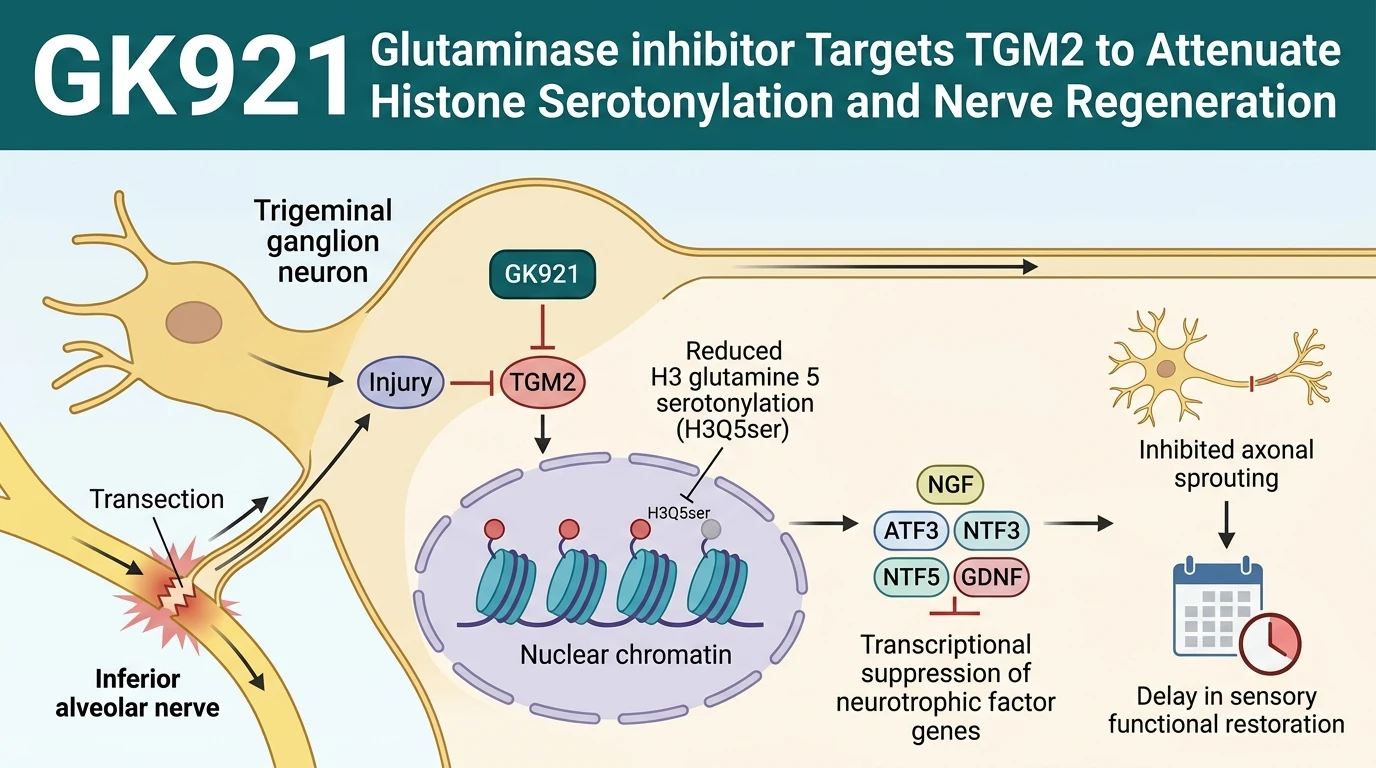
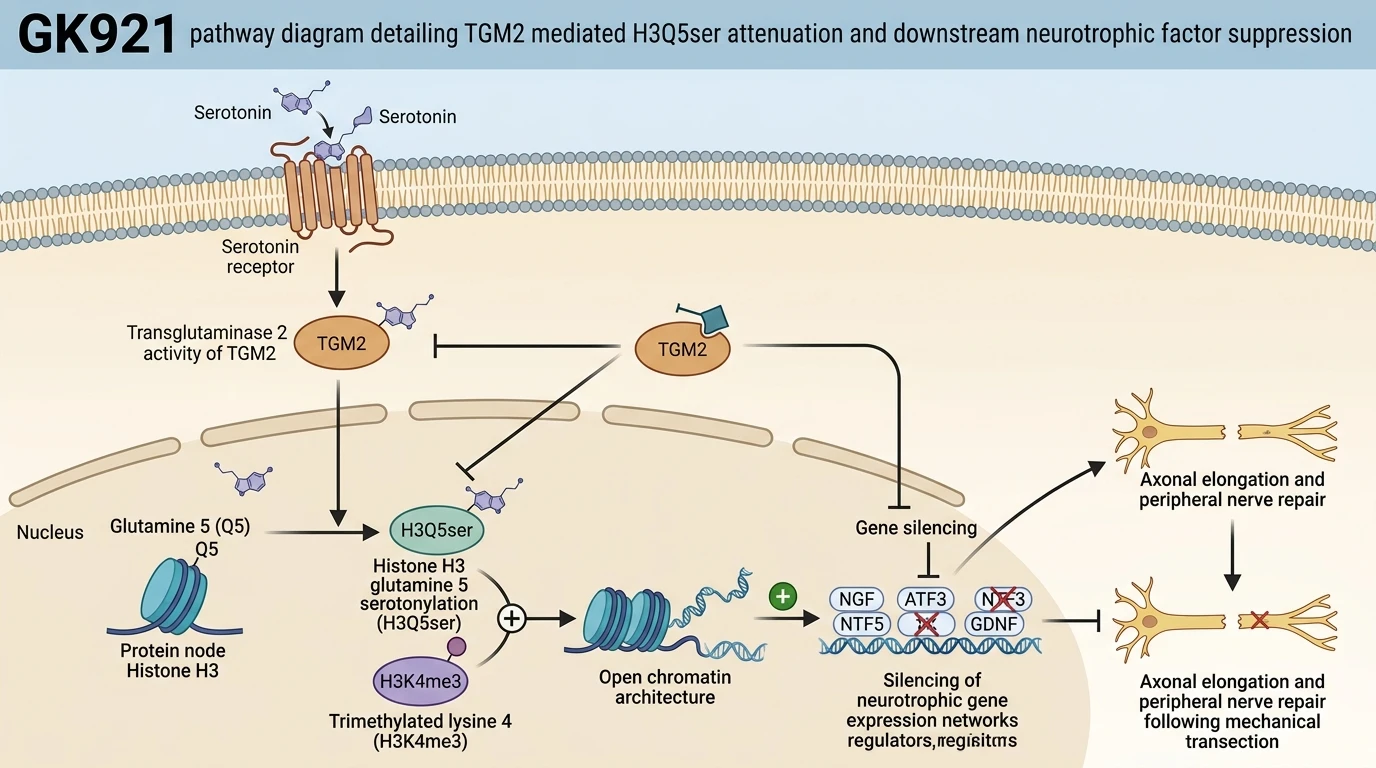
Serotonin operates beyond classical membrane receptor signaling through direct, covalent modification of nuclear histones. Transglutaminase 2 (TGM2), a calcium-dependent acyltransferase, catalyzes the transamidation of serotonin onto the glutamine 5 residue of histone H3. This modification yields histone H3 glutamine 5 serotonylation (H3Q5ser). The presence of H3Q5ser at gene promoter regions enhances the recruitment of transcription factor TFIID and operates cooperatively with histone H3 lysine 4 trimethylation (H3K4me3). This epigenetic tandem opens chromatin architecture, allowing RNA polymerase II to initiate high-volume transcription. In peripheral neural tissue, mechanical trauma triggers local serotonin release. Intracellular uptake of serotonin feeds nuclear TGM2 enzymatic pools, driving active chromatin remodeling required to initiate regenerative transcriptional programs.
Characterizing the precise contribution of TGM2-mediated transamidation requires robust chemical probes. The compound GK921 functions as a targeted inhibitor of TGM2 transamidase catalytic activity. In standardized biochemical screen databases, the small molecule is designated as a GK921 Glutaminase inhibitor owing to catalytically conserved features across glutamine-binding domains. Pharmacological application of GK921 suppresses TGM2-dependent crosslinking activity within sub-micromolar ranges in vitro. In primary cultured trigeminal ganglion neurons, stimulation with exogenous serotonin induces substantial neurite extension and dense axonal arborization. Co-incubation with GK921 abolishes serotonin-induced axonal elongation. Western blot analysis confirms a marked, dose-dependent decrease in global H3Q5ser levels following GK921 exposure. Total histone H3 expression remains unchanged, verifying that reduced signal reflects altered enzymatic modification rather than histone degradation.
Epigenetic profiling demonstrates that H3Q5ser deposition directly controls transcriptional activation of essential neuroregenerative cascades. Chromatin immunoprecipitation coupled with quantitative PCR reveals that TGM2 inhibition by GK921 prevents H3Q5ser enrichment at promoter regions of primary neurotrophic factors. Transcript levels for nerve growth factor (NGF), activating transcription factor 3 (ATF3), neurotrophin-3 (NTF3), neurotrophin-5 (NTF5), and glial cell line-derived neurotrophic factor (GDNF) drop significantly upon inhibitor exposure. Furthermore, transcriptomic analysis reveals concurrent downregulation of critical lipid metabolism genes necessary for axonal membrane synthesis and myelin sheath reassembly. The loss of these biosynthetic and neurotrophic outputs under GK921 treatment confirms that TGM2 transamidase activity is an essential driver of the transcriptional program governing peripheral axon outgrowth.
To establish translational relevance, researchers deployed GK921 in a mouse model of inferior alveolar nerve transection. Surgical transection creates a defined nerve injury gap that relies on endogenous repair signaling. Local administration of GK921 directly onto the transected nerve site attenuated H3Q5ser signal intensity within ipsilateral trigeminal ganglia over a multi-day post-injury window. Molecular analysis of ganglion tissue demonstrated corresponding reductions in NGF, ATF3, NTF3, NTF5, and GDNF protein expression levels. Functional recovery was evaluated using standardized behavioral assays measuring lower lip sensory restoration and mechanical withdrawal thresholds. Mice receiving GK921 exhibited significantly delayed recovery of lip sensation and reduced mechanical sensitivity compared to vehicle controls. These animal data confirm that localized TGM2 inhibition impairs intrinsic repair mechanisms in vivo. Epigenetic serotonylation mediated by TGM2 represents a non-redundant signal transducer required for successful peripheral nerve regeneration.
Structural alignment of TGM2 active site architecture highlights the catalytic Cys277-His335-Asp358 triad responsible for binding glutamine donors. Small-molecule binding of GK921 disrupts nucleophilic attack at this active site, competing directly with substrate access. Reduced TGM2 catalytic turnover halts the downstream enzymatic transfer of monoamines to nucleophilic glutamine sidechains. In peripheral sensory neurons, where metabolic flux shifts dramatically during axonal regeneration, this inhibition restricts chromatin accessibility at specific genomic loci. Consequently, RNA polymerase II elongation stalls at target neurotrophic genes. These structural and functional insights solidify the therapeutic paradigm of modulating TGM2 enzymatic activity to investigate chromatin dynamics during tissue damage and peripheral nerve repair.
Epigenetic Regulation of Peripheral Axonal Repair
Copy code to add this image to your page
GK921 inhibits transglutaminase 2 (TGM2) catalytic transamidase activity, preventing the covalent binding of serotonin to histone H3 glutamine 5 (H3Q5ser) in neuronal nuclei. Reduced H3Q5ser attenuates euchromatin structure and transcription factor recruitment at promoter regions of key neurotrophic factors, including NGF, ATF3, NTF3, NTF5, and GDNF, alongside lipid metabolic genes. In primary sensory neurons and inferior alveolar nerve injury models, TGM2 inhibition by GK921 suppresses serotonin-driven axonal elongation, suppresses tissue growth factor levels, and delays behavioral sensory recovery.
TGM2 Blockade Suppresses Neurotrophic Transcriptional Programs
In vitro primary trigeminal ganglion neuron assays demonstrate a clear functional link between TGM2 catalytic activity and axonal outgrowth. Serotonin exposure accelerates neurite elongation in cultured neurons. Application of the GK921 Glutaminase inhibitor completely blocks this serotonin-dependent response. Microscopic analysis confirms reduced axonal length across treated groups. Downstream gene expression dropped sharply within 24 hours of treatment. Quantitative reverse transcription PCR revealed marked repression of key neurotrophic factor transcripts, specifically NGF, ATF3, NTF3, NTF5, and GDNF. Additionally, expression of crucial lipid metabolism genes decreased significantly. Epigenetic analysis confirmed that these transcriptomic changes stemmed from reduced H3Q5ser levels at target promoter loci. Within this specific primary neuronal culture model, TGM2 transamidase activity acts as a prerequisite factor for neurotrophic transcription.
Local Inhibition Delays In Vivo Sensory Functional Recovery
To evaluate system-level effects, researchers utilized a murine inferior alveolar nerve transection model. Topical application of the GK921 Glutaminase inhibitor at the surgical site targeted local TGM2 transamidase activity directly. Ipsilateral trigeminal ganglia exhibited a substantial decline in nuclear H3Q5ser levels relative to vehicle-treated controls. Tissue protein analysis confirmed parallel decreases in NGF, ATF3, NTF3, NTF5, and GDNF accumulation. Sensory restoration was monitored over consecutive post-operative weeks. Behavioral testing revealed a significant delay in lower lip sensory recovery among inhibitor-treated mice. Mechanical sensitivity thresholds remained lower than baseline values throughout the observation period. The selectivity margin of local application prevented systemic off-target toxicity. These murine findings confirm that TGM2-dependent histone serotonylation is required for endogenous nerve repair and sensory re-innervation.