Nab-Paclitaxel and Dual HER2 Targeted Blockade in Neoadjuvant Breast Cancer Therapy
Copy code to add this image to your page
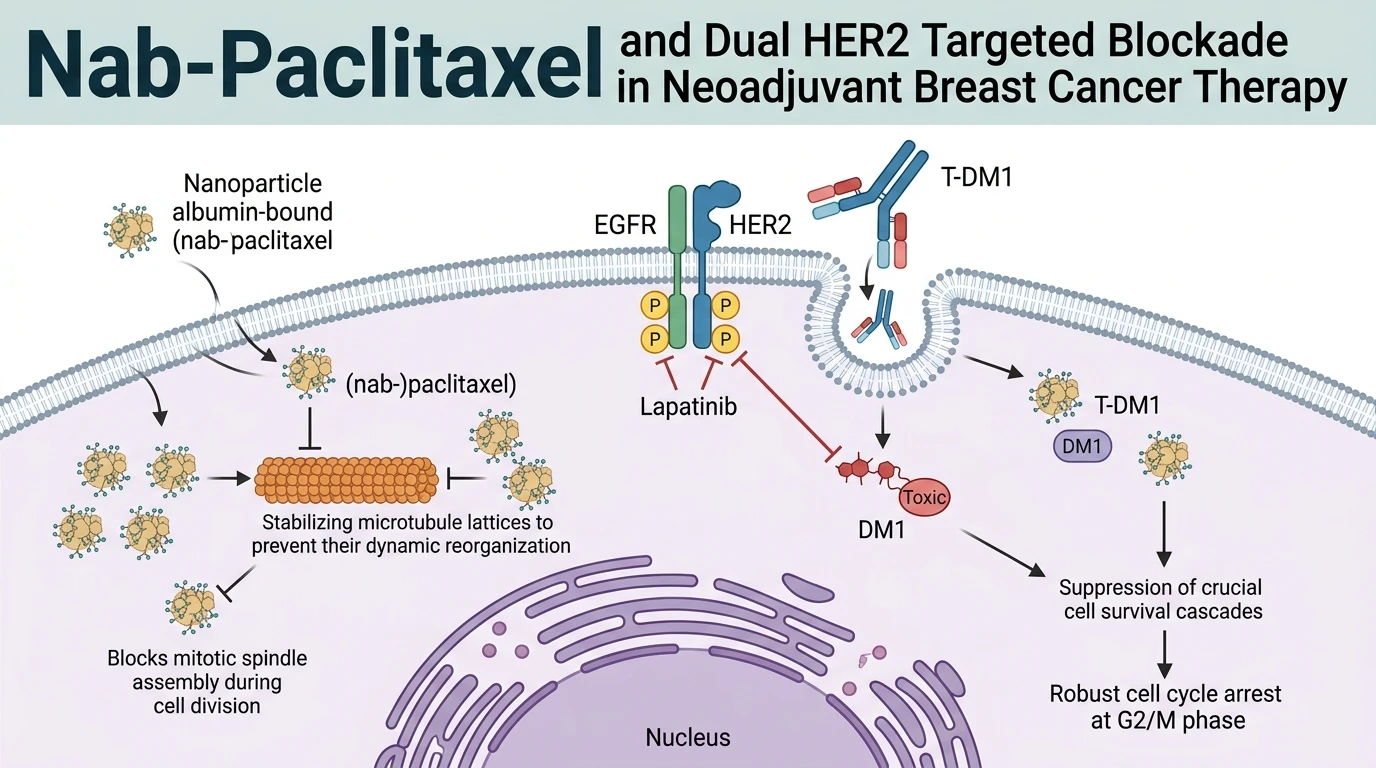
Microtubule assembly dynamics represent a vulnerable node in rapidly dividing malignant cells. Beta-tubulin heterodimers polymerize into cylindrical structures required for mitotic spindle formation, intracellular transport, and structural integrity. Paclitaxel binds specifically to the inner surface of the beta-tubulin subunit within assembled microtubules. This binding event stabilizes microtubule polymers, preventing necessary depolymerization during anaphase. Nanoparticle albumin-bound paclitaxel, designated as Nab-Paclitaxel, utilizes non-covalent albumin complexes to eliminate the requirement for synthetic surfactants such as Cremophor EL. Surfactant-free delivery enhances endothelial transcytosis via the albondin (gp60) receptor pathway, facilitating increased intratumoral drug accumulation. Methodological details regarding systemic toxicities and accumulation kinetics are widely documented in pharmacological evaluations of taxane formulations.
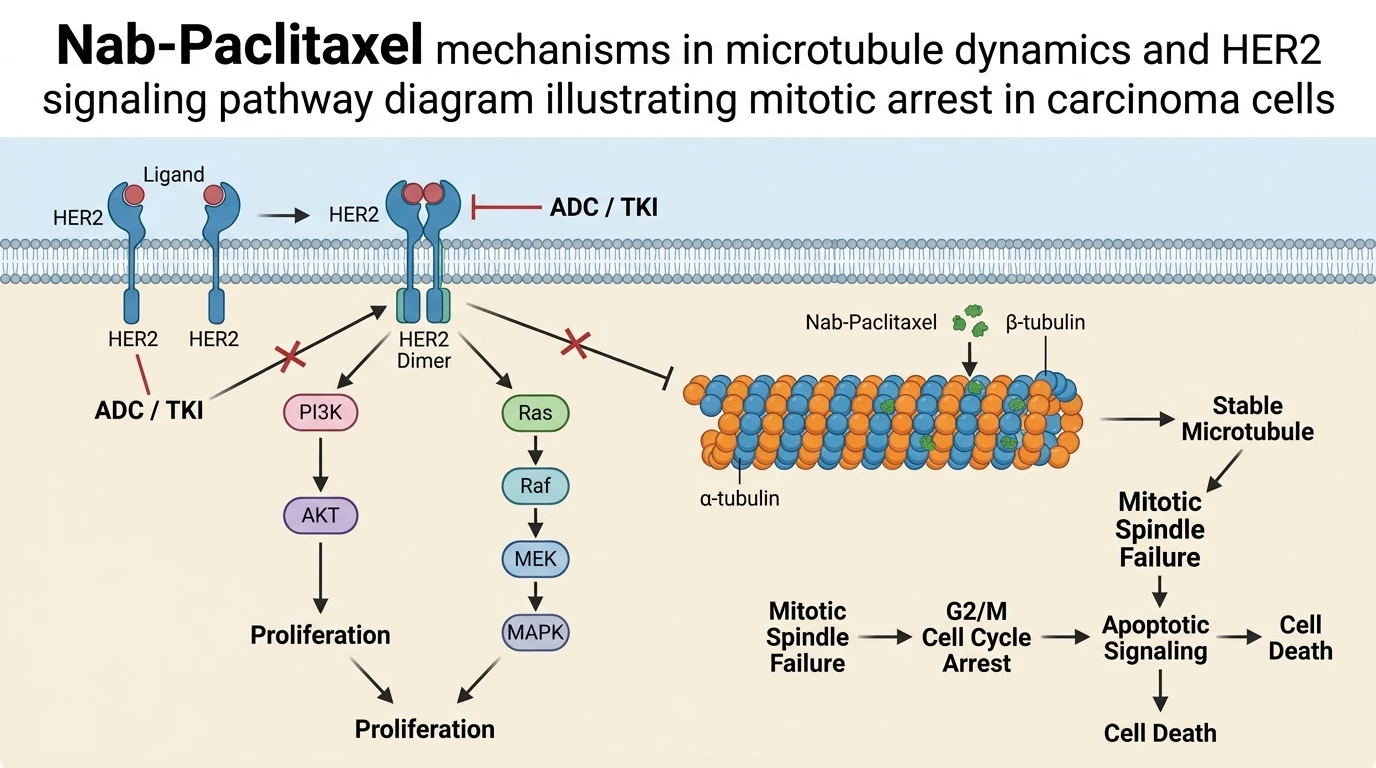
Human epidermal growth factor receptor 2 (HER2) functions as a transmembrane receptor tyrosine kinase that lacks a known direct ligand. Receptor activation occurs through homodimerization or heterodimerization with other EGFR family members, initiating autophosphorylation of C-terminal tyrosine residues. Phosphorylated motifs recruit adapter proteins that trigger intracellular PI3K-AKT-mTOR and Ras-Raf-MEK-ERK signaling cascades. Overexpression of HER2 drives unchecked cellular proliferation and suppresses pro-apoptotic mechanisms. Combining targeted anti-HER2 therapeutics disrupts these survival signals at complementary sites. Lapatinib functions as an ATP-competitive small-molecule inhibitor targeting both EGFR and HER2 intracellular kinase domains. Ado-trastuzumab emtansine (T-DM1) combines humanized trastuzumab with the cytotoxic anti-microtubule agent emtansine (DM1) via a stable thioether linker. Internalization of T-DM1 yields intracellular lysosomal degradation, releasing DM1 to bind tubulin at sites distinct from taxanes.
Endothelial transcytosis driven by albumin binding permits Nab-Paclitaxel to cross tumor microvessel walls via caveolae, delivering the taxane cargo into the interstitial space. Once localized in the tumor microenvironment, the drug readily diffuses into cancer cells to bind tubulin subunits. Combining this uptake mechanism with T-DM1 endocytosis creates a dense intracellular cytotoxic environment. Concurrently, lapatinib prevents compensatory cross-activation of EGFR signaling pathways that often bypass trastuzumab-mediated receptor suppression.
The phase II TEAL study investigated a neoadjuvant strategy combining three distinct pharmacological mechanisms: Nab-Paclitaxel, lapatinib, and T-DM1. This experimental triplet regimen was compared directly against the standard neoadjuvant regimen consisting of trastuzumab, pertuzumab, and paclitaxel in patients with early-stage HER2-positive breast cancer. The primary objective evaluated pathological eradication of malignant cells prior to surgical intervention. Endpoints were quantified using the Residual Cancer Burden (RCB) index, where RCB 0 indicates complete pathological response and RCB I represents minimal residual disease. Multi-agent targeting aimed to suppress redundant kinase signaling while simultaneously attacking the mitotic apparatus through dual tubulin binding modalities.
Interim efficacy analyses revealed substantial disparity between treatment arms. Patients in the experimental arm receiving T-DM1, lapatinib, and Nab-Paclitaxel achieved an RCB 0-I response rate of 100%, whereas patients receiving the control regimen achieved 62.5% (p = 0.0035). Subgroup analysis indicated that the difference was pronounced among estrogen receptor (ER)-positive individuals. Within the ER-positive subset, experimental therapy maintained a 100% RCB 0-I rate compared to 25% in the control cohort (p = 0.0035). ER signaling frequently provides an escape pathway that attenuates standard HER2-targeted cytotoxic therapies. Simultaneous disruption of dual kinase nodes and distinct microtubule binding sites appears to counter this resistance mechanism.
Both therapeutic regimens demonstrated acceptable tolerability profiles under monitored clinical trial conditions. Grade 3 and 4 toxicities remained within expected parameters without unexpected severe adverse event clusters. Because the experimental regimen achieved statistical superiority boundaries ahead of projected trial completion timelines, the trial was halted early. These results demonstrate that combining Nab-Paclitaxel with T-DM1 and lapatinib produces high rates of pathological response in early HER2-positive breast cancer without compromising safety metrics.
Neoadjuvant Efficacy and Pharmacodynamic Evaluation of Triplet Blockade
Copy code to add this image to your page
Nab-Paclitaxel stabilizes microtubule polymers to induce mitotic arrest, complementing intracellular payload delivery by T-DM1 and EGFR/HER2 kinase inhibition by lapatinib. In early-stage HER2-positive breast cancer, this neoadjuvant combination disrupts distinct oncogenic signaling nodes and cytoskeletal structures, significantly enhancing pathological response rates.
Complete Pathological Responses in Estrogen Receptor Positive Cohorts
The randomized phase II TEAL trial evaluated neoadjuvant treatment responses in early-stage HER2-positive breast cancer. Minimal residual disease rates reached absolute threshold values. Patients receiving ado-trastuzumab emtansine, lapatinib, and Nab-Paclitaxel achieved an overall Residual Cancer Burden 0-I response rate of 100% compared to 62.5% in the control arm (p = 0.0035). This therapeutic advantage was prominent among estrogen receptor-positive individuals. In this subpopulation, experimental treatment sustained a 100% response rate, whereas standard trastuzumab, pertuzumab, and paclitaxel achieved only 25% (p = 0.0035). Biochemical cross-talk between estrogen signaling and HER2 pathways often attenuates conventional cytotoxic efficacy. Simultaneous kinase suppression and microtubule stabilization effectively neutralized this resistance phenotype under observed clinical conditions.
Residual Cancer Burden Suppression Through Triplet Target Engagement
Mitotic arrest relies on precise tubular binding dynamics. By delivering non-solvent-bound taxane, Nab-Paclitaxel penetrates tumor parenchyma efficiently through receptor-mediated transcytosis. Concurrently, T-DM1 internalized intracellular emtansine to disrupt tubulin assembly at distinct binding pockets, while lapatinib continuously blocked intracellular kinase domains. Adverse event profiles remained comparable between treatment cohorts. Tolerability met predefined protocol benchmarks without unexpected toxicities. The trial halted early due to pre-specified interim superiority criteria. These observations confirm that multi-modal targeting suppresses primary tumor burden efficiently prior to surgical intervention.